My year 12 class have been studying the sixth book of Virgil’s Aeneid for their HSC this year. It’s a mysterious and evocative part of Virgil’s poem, in which the hero, Aeneas, descends to the underworld to visit his father. The other day we read Virgil’s description of the Elysium, the place of the blessed. This is how he describes it:
His demum exactis, perfecto munere divae,
devenere locos laetos et amoena virecta
fortunatorum nemorum sedesque beatas.
largior hic campos aether et lumine vestit
purpureo, solemque suum, sua sidera norunt.
pars in gramineis exercent membra palaestris,
contendunt ludo et fulva luctantur harena;
pars pedibus plaudunt choreas et carmina dicunt.
arma procul currusque virum miratur inanis;
stant terra defixae hastae passimque soluti
per campum pascuntur equi.
conspicit, ecce, alios dextra laevaque per herbam
vescentis laetumque choro paeana canentis
inter odoratum lauris nemus, unde superne
plurimus Eridani per silvam volvitur amnis.
When this rite was at last performed and his duty to the goddess was done, they entered the land of joy, the lovely glades of the fortunate woods and the home of the blest. Here a broader sky clothes the plains in glowing light, and the spirits have their own sun and their own stars. Some exercise their limbs on grassy wrestling grounds- they compete in sport and wrestle on the golden sand. Others pound the earth with their feet in dance, and sing songs.
Aeneas admires from a distance their armour and empty chariots. their spears stand, fixed in the ground, and their horses wander free on the plain, cropping the grass.
Then suddenly he sees others on the left and on the right, feasting on the grass, singing in chorus a joyful hymn to Apollo, all through a grove of fragrant laurels, where the mighty river Eridanus winds its way through the woods to the world above.
(Aeneid 6.637-44, 51-3, 56-9)
Here's an interesting article which compares Virgil's description of the underworld to that of Homer in book XI of the Odyssey, and also contains a glossary of names and places mentioned in book VI of the Aeneid.
Thursday, August 31, 2006

Monday, August 28, 2006
bloggo ergo sum
Joeline has asked me about the origins of the word 'blog', so I've done some research and found the following:
bloggo, bloggere, bloggi, bloxus v. itr. (ante class.: blogo) [root: Sanscr. bhloch-; Gr. βλογω (perh. related to λογος?); Anglo-Saxon bloghæn] 1. To waste time; 2. To annoy friends with the inanities of one’s daily life; 3. To make lame jokes (only in prose).
Examples from Latin literature:
odi et bloggo.
I hate, and I blog.
(Catullus)
arma virumque bloggo
I blog about wars, and a man…
(Virgil)
bloggo ergo sum
I blog therefore I am.
(Descartes)
veni, vidi, bloggi.
I came, I saw, I posted the pictures on my blog.
(Julius Caesar)
bloggo, bloggere, bloggi, bloxus v. itr. (ante class.: blogo) [root: Sanscr. bhloch-; Gr. βλογω (perh. related to λογος?); Anglo-Saxon bloghæn] 1. To waste time; 2. To annoy friends with the inanities of one’s daily life; 3. To make lame jokes (only in prose).
Examples from Latin literature:
odi et bloggo.
I hate, and I blog.
(Catullus)
arma virumque bloggo
I blog about wars, and a man…
(Virgil)
bloggo ergo sum
I blog therefore I am.
(Descartes)
veni, vidi, bloggi.
I came, I saw, I posted the pictures on my blog.
(Julius Caesar)
Thursday, August 24, 2006
On this day...
gratias maximas to Ruth, who reminded me that today is the anniversary of the eruption of Mt Vesuvius in 79 A.D.
Here's an extract from Pliny the younger's famous description of the event, as he observed it from Misenum, across the bay from Pompeii:
iam cinis, adhuc tamen rarus. respicio: densa caligo tergis imminebat, quae nos torrentis modo infusa terrae sequebatur. ‘deflectamus’ inquam ‘dum videmus, ne in via strati comitantium turba in tenebris obteramur.’ vix consideramus, et nox - non qualis illunis aut nubila, sed qualis in locis clausis lumine exstincto.
audires ululatus feminarum, infantum quiritatus, clamores virorum; alii parentes alii liberos alii coniuges vocibus requirebant, vocibus noscitabant; hi suum casum, illi suorum miserabantur; erant qui metu mortis mortem precarentur; multi ad deos manus tollere, plures nusquam iam deos ullos aeternamque illam et novissimam noctem mundo interpretabantur. nec defuerunt qui fictis mentitisque terroribus vera pericula augerent... possem gloriari non gemitum mihi, non vocem parum fortem in tantis periculis excidisse, nisi me cum omnibus, omnia mecum perire misero, magno tamen mortalitatis solacio credidissem.
Ashes were already falling, not as yet very thickly. I looked round: a dense black cloud was coming up behind us, spreading over the earth like a flood. ‘Let us leave the road while we can still see, ‘I said, ‘or we shall be knocked down and trampled underfoot in the dark by the crowd behind.’ We had scarcely sat down to rest when darkness fell, not the dark of a moonless or cloudy night, but as if the lamp had been put out in a closed room.
You could hear the shrieks of women, the wailing of infants, and the shouting of men; some were calling their parents, others their children or their wives, trying to recognize them by their voices. People bewailed their own fate or that of their relatives, and there were some who prayed for death in their terror of dying. Many besought the aid of the gods, but still more imagined there were no gods left, and that the universe was plunged into eternal darkness for evermore… I could boast that not a groan or cry of fear escaped me in these perils, but I admit that I derived some poor consolation in my mortal lot from the belief that the whole world was dying with me and I with it.
Pliny the younger, Epistularum libri decem VI.20
Here's an extract from Pliny the younger's famous description of the event, as he observed it from Misenum, across the bay from Pompeii:
iam cinis, adhuc tamen rarus. respicio: densa caligo tergis imminebat, quae nos torrentis modo infusa terrae sequebatur. ‘deflectamus’ inquam ‘dum videmus, ne in via strati comitantium turba in tenebris obteramur.’ vix consideramus, et nox - non qualis illunis aut nubila, sed qualis in locis clausis lumine exstincto.
audires ululatus feminarum, infantum quiritatus, clamores virorum; alii parentes alii liberos alii coniuges vocibus requirebant, vocibus noscitabant; hi suum casum, illi suorum miserabantur; erant qui metu mortis mortem precarentur; multi ad deos manus tollere, plures nusquam iam deos ullos aeternamque illam et novissimam noctem mundo interpretabantur. nec defuerunt qui fictis mentitisque terroribus vera pericula augerent... possem gloriari non gemitum mihi, non vocem parum fortem in tantis periculis excidisse, nisi me cum omnibus, omnia mecum perire misero, magno tamen mortalitatis solacio credidissem.
Ashes were already falling, not as yet very thickly. I looked round: a dense black cloud was coming up behind us, spreading over the earth like a flood. ‘Let us leave the road while we can still see, ‘I said, ‘or we shall be knocked down and trampled underfoot in the dark by the crowd behind.’ We had scarcely sat down to rest when darkness fell, not the dark of a moonless or cloudy night, but as if the lamp had been put out in a closed room.
You could hear the shrieks of women, the wailing of infants, and the shouting of men; some were calling their parents, others their children or their wives, trying to recognize them by their voices. People bewailed their own fate or that of their relatives, and there were some who prayed for death in their terror of dying. Many besought the aid of the gods, but still more imagined there were no gods left, and that the universe was plunged into eternal darkness for evermore… I could boast that not a groan or cry of fear escaped me in these perils, but I admit that I derived some poor consolation in my mortal lot from the belief that the whole world was dying with me and I with it.
Pliny the younger, Epistularum libri decem VI.20
Tuesday, August 22, 2006
Brought to you by the letter C

Here are five Latin words starting with C, for the enjoyment of my year 8 class:
catillo: a plate licker
concursator: one who runs hither and thither
corpulentus: corpulent, fleshy, fat
crapulentus: very much intoxicated
crispulus: curled, having curled hair, crisped, crimped
Definitions from A Latin Dictionary, Lewis and Short
Monday, August 21, 2006
Monday, period 4
Good Morning year 9! Your task today, should you choose to accept it, is to visit the Cambridge course website, and do some of the grammar and vocabulary exercises from the last couple of stages. If you've finished with those, you can visit this site, and have a go at some on-line trivia quizes, or this site to play hangman in Latin.
Thursday, August 17, 2006
ars oratoris
I came across a site yesterday which should be helpful to my year 11 and 12 students studying Cicero at the moment. It offers an exhaustive glossary of rhetorical terms, and gives examples of how they are used from a variety of classical and modern sources. If you've ever wondered what aposiopesis or paronomasia mean, this is the site for you! Here's a short example:
Alliteration
Repetition of the same sound beginning several words in sequence.
*Let us go forth to lead the land we love. J. F. Kennedy, Inaugural
*Viri validis cum viribus luctant. Ennius
*Veni, vidi, vici. Julius Caesar
Alliteration
Repetition of the same sound beginning several words in sequence.
*Let us go forth to lead the land we love. J. F. Kennedy, Inaugural
*Viri validis cum viribus luctant. Ennius
*Veni, vidi, vici. Julius Caesar
Tuesday, August 15, 2006
Mysterious Myths and Legendary Legends
I'm reading an interesting (but slightly odd) book on mythology at the moment. It's called The Seven Sisters of the Pleiades by Munya Andrews. The Pleiades are a cluster of stars, if you didn't know, and this book compares the stories told about them in different cultures from across the world. Andrews herself is a Nyigina woman from Noonkanbah, and grew up in the Kimberley region of Western Australia. She begins by telling the story she learnt from her grandmother as a child, and compares this story to those in Greek, American Indian, Indian, Egyptian, Maori, and Japanese mythology, drawing attention to some really interesting parallels between the stories. She talks about the mystical significance of the number seven, noting its importance in biblical literature, and pointing out that most of the stories associated with the Pleiades involve seven stars, even in places where (due to a higher altitude, or particularly clear skies) more than seven (up to thirteen) stars are visible. She also notes that all bar one of the myths she has found imagine the Pleiades as women, and that there is common thread of 'lostness' in many of the stories. These are interesting parallels, but it's hard to know what (if anything) they signify. I mentioned before that the book was slightly odd- here's one passage that might serve to illustrate my point.
"What is enormously interesting about our widespread preoccupation with the number seven in many creation stories is the revelation that genetic analysis of people of European descent traces DNA carried only in female mitochondrial genes to seven primordial 'clan-mothers'... Does this mean that our holotropic memory of the Pleaides is not only cultural but that the Dreaming of the Seven Sisters may be literally carried in our blood and our genes?"
Strong Bad also has an interesting post on the origins and evolution of myths.
"What is enormously interesting about our widespread preoccupation with the number seven in many creation stories is the revelation that genetic analysis of people of European descent traces DNA carried only in female mitochondrial genes to seven primordial 'clan-mothers'... Does this mean that our holotropic memory of the Pleaides is not only cultural but that the Dreaming of the Seven Sisters may be literally carried in our blood and our genes?"
Strong Bad also has an interesting post on the origins and evolution of myths.
Thursday, August 10, 2006
Word of the day
The word for today is humiliated, as in "Last night my oztag team was humiliated ." It comes from the Latin 'humilis' meaning 'low' and therefore 'humble', which in turn derives from the word 'humus', meaning 'earth' or 'ground'. And so to be humiliated is to be lowered or humbled, or even to be brought down to earth.
Wednesday, August 09, 2006
Quid est?

What is it? It's a new species of tentacled worm, discovered a couple of years ago, growing on some whale bones at the bottom of the North Sea, off the coast of Sweden. The Scientists who discovered it decided to name it osedax mucofloris- which is Latin for "bone-eating snot-flower".
Tuesday, August 08, 2006
Cicero, de morte
nam si supremus ille dies non exstinctionem, sed commutationem affert loci, quid optabilius? sin autem perimit ac delet omnino, quid melius quam in mediis vitae laboribus obdormiscere et ita coniventem somno consopiri sempiterno?
Tusculanae Quaestiones 1.117
For if that final day brings not extinction, but a change of place, what could be more desirable? But if it destroys and annihilates us completely, what could be better than to fall asleep in the midst of life's sufferings, and closing our eyes in this way to rest in eternal slumber?
Tusculanae Quaestiones 1.117
For if that final day brings not extinction, but a change of place, what could be more desirable? But if it destroys and annihilates us completely, what could be better than to fall asleep in the midst of life's sufferings, and closing our eyes in this way to rest in eternal slumber?
Friday, August 04, 2006
Brought to you by the letter M

Here are five interesting (though not particularly useful) Latin words starting with 'M':
malogranata: a pomegranate tree
manipulus: pieces of metal held in the hand during gymnastic exercises, to increase the momentum of a leap or stroke
mansuetarius: a tamer of wild beasts
manticularia: handy little things, things in constant use
masculesco: to become male
Definitions from A Latin Dictionary, Lewis and Short
De Animo
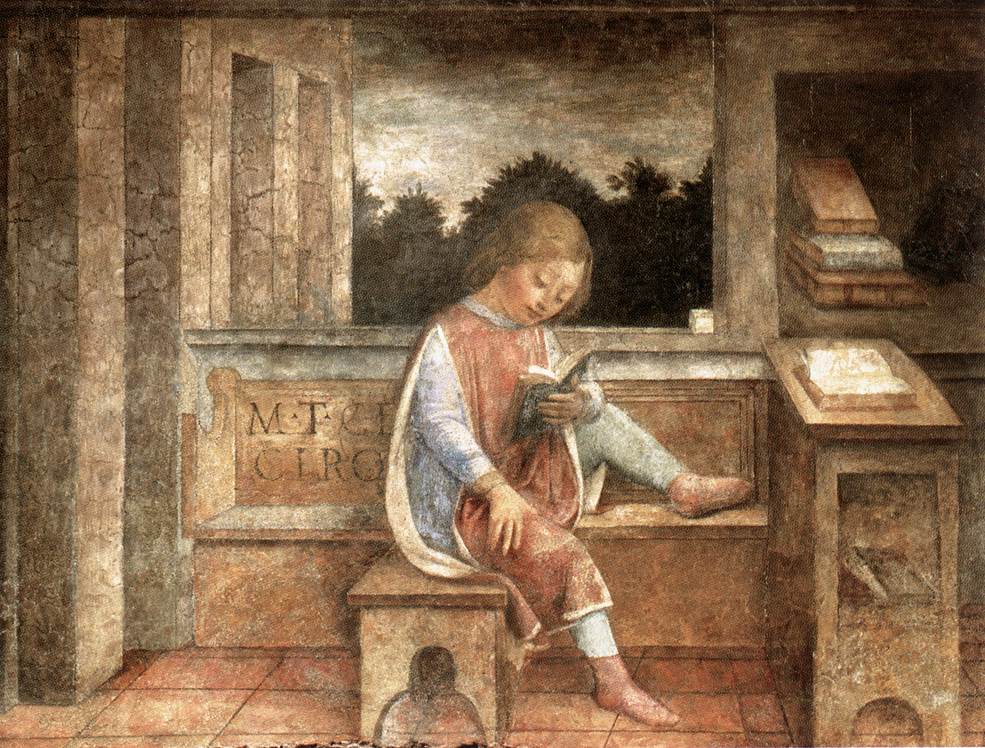
Here's a practise essay question for my year 12 extension students, studying madly for their exam next week:
Cum ergo est somno sevocatus animus a societate et a contagione corporis, tum meminit praeteritorum, praesentia cernit, futura providet; iacet enim corpus dormientis ut mortui, viget autem et vivit animus. Quod multo magis faciet post mortem, cum omnino corpore excesserit. Itaque adpropinquante morte multo est divinior. Nam et id ipsum vident, qui sunt morbo gravi et mortifero affecti, instare mortem; itaque iis occurrunt plerumque imagines mortuorum, tumque vel maxime laudi student, eosque, qui secus quam decuit vixerunt, peccatorum suorum tum maxime paenitet.
(Cicero, De Divinatione I.63)
Praeterea gigni pariter cum corpore et una
crescere sentimus pariterque senescere mentem.
nam vel ut infirmo pueri teneroque vagantur
corpore, sic animi sequitur sententia tenvis.
inde ubi robustis adolevit viribus aetas,
consilium quoque maius et auctior est animi vis.
post ubi iam validis quassatum est viribus aevi
corpus et obtusis ceciderunt viribus artus,
claudicat ingenium, delirat lingua labat mens,
omnia deficiunt atque uno tempore desunt.
ergo dissolvi quoque convenit omnem animai
naturam, ceu fumus, in altas aëris auras;
quando quidem gigni pariter pariterque videmus
crescere et, ut docui, simul aevo fessa fatisci.
(Lucretius, De Rerum Natura, III.445-458)
Compare the arguments on the nature of the soul in each of these passages and analyse the language used to express each view.
Wednesday, August 02, 2006
Why I didn't do my homework
in domum meam perperam incurrentes, vigiles qui exsequuntur usum medicamentorum illicitorum nimis studiosi pensum domesticum pro testimonio iniuste abstulerunt.
[My homework was seized as evidence by mistake by CIA agents in a drug bust at the wrong address.]
orbe terrarium nimuim calefacto combustione hydrogonanthracum, pensum meum domesticum sua sponte flammam concepit.
[Due to global warming, my homework spontaneously combusted.]
[My homework was seized as evidence by mistake by CIA agents in a drug bust at the wrong address.]
orbe terrarium nimuim calefacto combustione hydrogonanthracum, pensum meum domesticum sua sponte flammam concepit.
[Due to global warming, my homework spontaneously combusted.]
Subscribe to:
Posts (Atom)


