If you could have dinner with three Romans, who would you invite? I was thinking about this the other day, and here is my guest list:
Cicero was my first choice. I suspect that he was a bit of an arrogant git, but there’s no doubt that the man was a genius. From humble(ish) origins he rose to become one of the most influential men in Rome. He was consul in 63 BC, and Julius Caesar invited him to join the first triumvirate (Cicero refused because he hated Caesar, but that’s another story). He had a sense of humour and a bitterly sharp wit, and was incredibly educated- he studied oratory in Athens, and in his later years when he was effectively side-lined from politics he spent his spare time translating Greek philosophy into Latin. He also lived in one of the most interesting periods of time in Roman history- the final years of the republic- and knew lots of fascinating people- not only Caesar, but Antony, Octavian, Cleopatra, Catullus (and Lesbia/Clodia). He didn’t like most of them, but that only makes him a more entertaining guest.
It would be tempting to invite some of Cicero’s acquaintances (perhaps Catullus and Lesbia?) just to watch the fireworks, but in the interest of variety my next guest would be Agrippina, mother of the emperor Nero. Agrippina was one of the last of the fascinating, but troubled, Julio-Claudian family. Her brother was the emperor Caligula, and her uncle (later also her husband) was the emperor Claudius. Caligula didn’t like her much (he sent her into exile) but she had considerable influence over Claudius, and when Nero came to power she was for a time effectively co-emperor. Later Nero grew to resent her, and eventually had her killed. Such a powerful and ambitious woman so closely connected to three different emperors would undoubtedly have a few good stories to tell, though you’d probably need to watch the food closely (she was said to have poisoned Claudius).
I can imagine the conversation at my dinner party getting pretty heavy with those two, and can think of no one better to liven the mood than the poet Ovid. Whereas Cicero’s humour was (I suspect) bitter and vicious, Ovid comes across in his poetry as fun-loving, warm and generous, if sometimes a bit vulgar. At times he is completely over the top and it seems like he has trouble taking anything seriously, though he was by no means a light-weight- in addition to his love poems and manuals he wrote mythological poems (not just the light-hearted Metamorphoses, but the Heroides as well), a kind of historical calendar (the Fasti) and a version of Medea, sadly lost to us. As part of the literary circle of Maecenas he knew many of the other eminent poets of his day (Propertius, Tibullus and Horace for example), and probably Augustus himself. Whether he knew Augustus personally or not he certainly did something to upset him (we don’t know exactly what- it’s one of the things I would ask him if I had the chance), and he was banished from Rome in AD 17 never to return.
That’s my list, who would you invite?
Showing posts with label cleopatra. Show all posts
Showing posts with label cleopatra. Show all posts
Monday, June 02, 2008

Tuesday, May 13, 2008
books
Every month I get an Abbeys catalogue in the mail- I thought I’d post the reviews of some of the book which looked interesting to me from this month’s catalogue.
Imprimatur11 September 1683, Rome. The citizens of the city wait anxiously for the outcome of the battle for Vienna as Ottoman forces lay siege to the defenders of Catholic Europe. Meanwhile, a suspected outbreak of plague causes a famous Roman tavern to be placed under quarantine. A plot to assassinate the pope and plans to use the plague as a weapon of mass destruction in the battle between Islam and the West are discovered. Drawing on original papers discovered in the Vatican archives, this meticulously researched and brilliantly conceived thriller sheds new light on the power struggles of 17th century Europe, the repercussions of which are still felt today.
Cleopatra: Last Queen of EgyptShe was the last ruler of the Macedonian dynasty of Ptolemies who had ruled Egypt for three centuries. Highly educated (the only one of the Ptolemies to read and speak ancient Egyptian, as well as the court Greek) and very clever (her famous liaisons with Julius Caesar and Mark Antony were as much to do with politics as the heart), she steered her kingdom through impossibly taxing internal problems and against greedy Roman imperialism. Stripping away our preconceptions (many of which are as old as her Roman enemies) in this magnificent biography, Tyldesley uses all her skills as an Egyptologist to give us a rich picture of a country and its Egyptian queen.
A Brief History of the Private Lives of Roman EmperorsBlond’s scandalous expose on the life of the Caesar’s is a must-read for anyone interested in what really went on in ancient Rome. Julius Caesar is usually presented as a glorious general, when in fact he was an arrogant charmer and a swank. Augustus was so conscious of his height that he put lifts in his sandals. But they were nothing compared to Caligula, Claudius and Nero! This book makes fascinating reading, eye-opening in its revelations and endlessly entertaining.
Friday, May 09, 2008
superbus
Superbus is an odd Latin word. It’s obviously the root of ‘superb’, but the meaning of the Latin word is quite different to that of its English derivative, which generally has only positive connotations. Superbus has the basic meaning of ‘proud’, but can be used in a positive or a negative sense. For example in Book VIII of the Aeneid (where the word occurs seven times), it can be used to describe Hercules, the heroic slayer of the monster Cacus (and 'type' of Augustus):
nam maximus ultor
tergemini nece Geryonae spoliisque superbus
Alcides aderat…
For our great avenger, the son of Alceus [Hercules] was at hand, exalting in the death and spoils of three-bodied Geryon…
nam maximus ultor
tergemini nece Geryonae spoliisque superbus
Alcides aderat…
For our great avenger, the son of Alceus [Hercules] was at hand, exalting in the death and spoils of three-bodied Geryon…
Virgil, Aeneid VIII.201-2
Tuesday, July 25, 2006
Queen Bee or Wannabe?
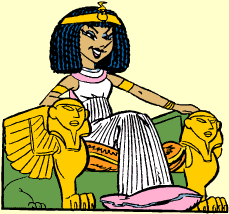
Here is a guest post from my wonderful year 9 class.
Ambitious queen? Extravagant flirt? Inspirational role-model? Treacherous temptress? Tragic Hero?
Cleopatra, one of the most powerful women in Roman history, was a controversial figure in her own time, and after more than 2000 years her true character remains an enigma. Last term an elite team of historical researchers (the year nine Latin class) spent a week delving into the mysterious past of Egypt’s most famous queen to see what we could discover. As part of our research we examined:
- original Latin and Greek sources, such as Plutarch, Horace, Cassius Dio and Lucan
- coins, pictures and statues from Cleopatra’s own time
- the theories of modern day historians
After much investigation and lengthy debate, we decided that whatever else Cleopatra might have been, even after 2000 years she remains a memorable example of female leadership. She was powerful, ambitious and knew how to make the most of her abilities. She was fiercely intelligent and was able to manipulate two of the most powerful Roman men at that time – Julius Caesar and Marc Antony – to get what she wanted. She was also terribly proud, and is said to have committed suicide rather than face humiliation at the hands of the Romans.
However our class was divided as to whether Cleopatra is a good role model for the well-rounded young women of today. Some admired her drive and determination to achieve her goals. Others felt that the means she used to obtain power were dishonest, and that in manipulating those around her she sacrificed her integrity. We also found that Cleopatra shares many qualities with modern day celebrities such as Nikki Webster, Princess Mary, Paris Hilton, Angelina Jolie, Jude Law and Queen Elizabeth II.
To investigate the mystery of Cleopatra further, click here
Subscribe to:
Posts (Atom)


