WARNING: If you visit the site, some of them are a bit rude...
Showing posts with label dido. Show all posts
Thursday, April 07, 2011
Crocodile Classics
My year 12 class have brought Crocodile Classics to my attention. I'm not sure how to best describe it, so here are a few examples of what you'll find there.
Wednesday, October 04, 2006
Aeneid part IV- A Tragic Loss
Aeneid II.776-784
"quid tantum insano iuvat indulgere dolori,
o dulcis coniunx? non haec sine numine divum
eveniunt; nec te comitem hinc portare Creusam
fas, aut ille sinit superi regnator Olympi.
longa tibi exsilia et vastum maris aequor arandum,
et terram Hesperiam venies, ubi Lydius arva
inter opima virum leni fluit agmine Thybris.
illic res laetae regnumque et regia coniunx
parta tibi; lacrimas dilectae pelle Creusae."
"O dear husband, why does it please you so much to indulge this mad grief? These things do not happen without the will of the gods; it was not right for you to carry your companion Creusa from here, nor does the ruler of Olympus above allow it. There is in store for you a long exile and the vast plain of the sea to be ploughed, before you come to land of Hesperia, where the Lydian Tiber flows in a gentle stream, amidst the fertile fields of men. There a happy fate awaits you, and a kingdom, and a royal bride; stop your tears for your beloved Creusa."
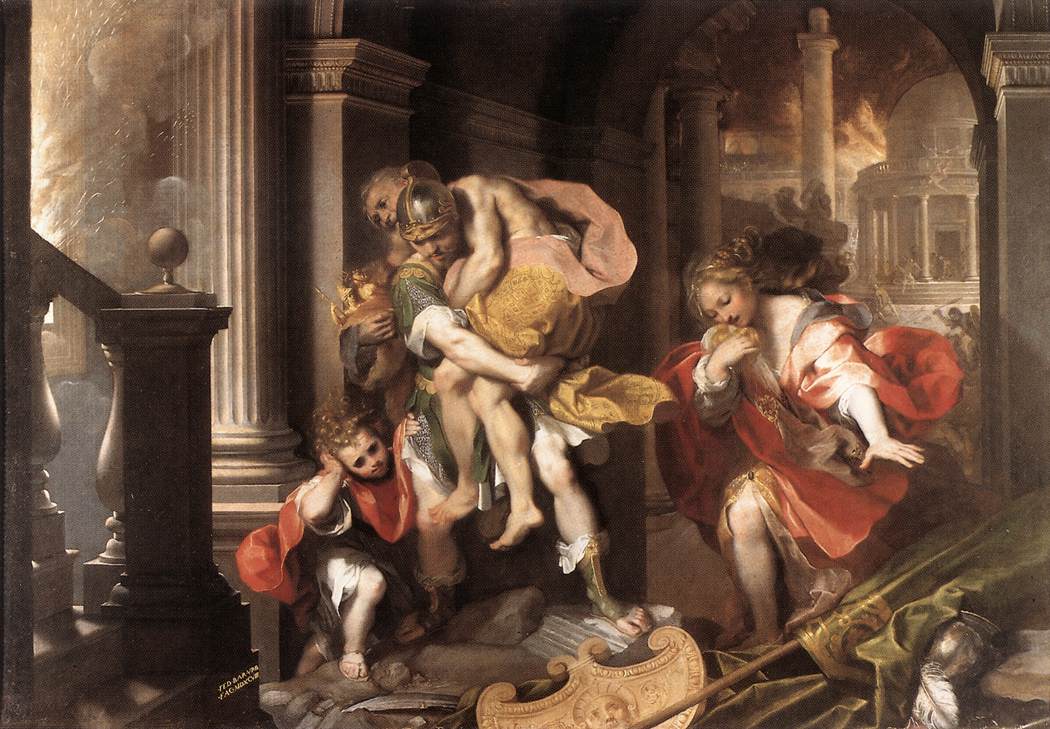
As Aeneas reaches the safety of the hills outside Troy with his father and young son, he suddenly notices that his wife, Creusa, is no longer with him. He rushes impetuously back to the burning city to try to find her, but to no avail. Finally her ghost appears to him in this passage, and reminds him of the destiny which awaits him in Italy (‘the land of Hesperia’). Creusa’s death at this point is a necessary plot device for Virgil. Not only does it allow him to emphasise Aeneas' destiny, but he also needs to get Creusa out of the way fairly quickly so that he can introduce the relationship between Aeneas and Dido. It is interesting that when Aeneas visits the underworld (book VI) he meets the ghost of Dido in a highly emotional scene, and is reunited with his dead father (more on this later), but nowhere is Creusa mentioned.
We also see again in this passage an important aspect of pietas. Aeneas’ desperate search for his wife amid the destruction of Troy is bravely heroic, and possibly even romantic, but that is not how Creusa describes it- she calls it an insano dolori- a mad grief. The pius thing for Aeneas to do in this situation is to recognise the will of the gods (as Creusa urges Aeneas to do), and to get on with the destiny that lies before him, not giving in to the pain he feels. This seems a little heartless, but it is a very Roman idea, and one found often in Stoic philosophy, which held that it was possible to overcome the discord of the outside world and find peace within oneself, by mastering one’s passions and emotions.
"quid tantum insano iuvat indulgere dolori,
o dulcis coniunx? non haec sine numine divum
eveniunt; nec te comitem hinc portare Creusam
fas, aut ille sinit superi regnator Olympi.
longa tibi exsilia et vastum maris aequor arandum,
et terram Hesperiam venies, ubi Lydius arva
inter opima virum leni fluit agmine Thybris.
illic res laetae regnumque et regia coniunx
parta tibi; lacrimas dilectae pelle Creusae."
"O dear husband, why does it please you so much to indulge this mad grief? These things do not happen without the will of the gods; it was not right for you to carry your companion Creusa from here, nor does the ruler of Olympus above allow it. There is in store for you a long exile and the vast plain of the sea to be ploughed, before you come to land of Hesperia, where the Lydian Tiber flows in a gentle stream, amidst the fertile fields of men. There a happy fate awaits you, and a kingdom, and a royal bride; stop your tears for your beloved Creusa."
As Aeneas reaches the safety of the hills outside Troy with his father and young son, he suddenly notices that his wife, Creusa, is no longer with him. He rushes impetuously back to the burning city to try to find her, but to no avail. Finally her ghost appears to him in this passage, and reminds him of the destiny which awaits him in Italy (‘the land of Hesperia’). Creusa’s death at this point is a necessary plot device for Virgil. Not only does it allow him to emphasise Aeneas' destiny, but he also needs to get Creusa out of the way fairly quickly so that he can introduce the relationship between Aeneas and Dido. It is interesting that when Aeneas visits the underworld (book VI) he meets the ghost of Dido in a highly emotional scene, and is reunited with his dead father (more on this later), but nowhere is Creusa mentioned.
We also see again in this passage an important aspect of pietas. Aeneas’ desperate search for his wife amid the destruction of Troy is bravely heroic, and possibly even romantic, but that is not how Creusa describes it- she calls it an insano dolori- a mad grief. The pius thing for Aeneas to do in this situation is to recognise the will of the gods (as Creusa urges Aeneas to do), and to get on with the destiny that lies before him, not giving in to the pain he feels. This seems a little heartless, but it is a very Roman idea, and one found often in Stoic philosophy, which held that it was possible to overcome the discord of the outside world and find peace within oneself, by mastering one’s passions and emotions.
Aeneid part III- The End of an Era
Aeneid II.3-17
infandum, regina, iubes renovare dolorem,
Troianas ut opes et lamentabile regnum
eruerint Danai, quaeque ipse miserrima vidi
et quorum pars magna fui. quis talia fando
Myrmidonum Dolopumve aut duri miles Ulixi
temperet a lacrimis? et iam nox umida caelo
praecipitat suadentque cadentia sidera somnos.
sed si tantus amor casus cognoscere nostros
et breviter Troiae supremum audire laborem,
quamquam animus meminisse horret luctuque refugit,
incipiam. fracti bello fatisque repulsi
ductores Danaum tot iam labentibus annis
instar montis equum divina Palladis arte
aedificant, sectaque intexunt abiete costas;
votum pro reditu simulant; ea fama vagatur.
“Unspeakable, O Queen, is the grief you order me to renew, how the Greeks destroyed the wealth of Troy and that mournful kingdom- I myself saw these most wretched things, and was a large part of them. Which soldier of the Myrmidons or the Dolopians or of cruel Ulysses would refrain from tears in the telling of such things? And now the dewy night rushes from the sky, and the falling stars urge sleep. But if you have such a great desire to learn of our misfortunes, and to hear briefly of the final suffering of Troy- although my mind shudders and recoils from the grief- I shall begin. Broken by war, and driven back by the fates, the leaders of the Greeks, with so many years now slipping away, build with the divine skill of Minerva, a horse the size of a mountain, and weave its ribs from planks of fir-wood; they pretend it is an offering to the gods for their safe return; this is the rumour which spreads.”
Having been shipwrecked on the coast of Africa, Aeneas and his men end up in Carthage, where Queen Dido welcomes them kindly. She has heard of the fame and sufferings of the Trojans and over a lavish banquet held in their honour (during which she begins to fall for Aeneas) she asks him to tell the story of the treachery of the Greeks, the sufferings of his people, and his own journey since leaving Troy. Aeneas obliges, and books II and III of the Aeneid are Aeneas’ recounting of the fall of Troy (book II) and his wanderings around the Mediterranean in search of a new homeland for his people (book III).
Aeneas’ narration of the destruction of Troy is an emotionally intense tale, full of pathos and drawing from elements of Greek tragedy. But it is more than that. As we have seen before, the progression from Troy to Rome is an important theme for Virgil, especially in the character of Aeneas. Aeneas’ journey from Troy can be seen as his journey away from the old model of heroism, towards a new and better ideal, characterised by pietas. Thus the city of Troy itself stands for the out-dated values of the heroic age, and its destruction is an important moment; the passing of the old is necessary so that something greater- Rome- may arise. Significantly the destruction of Troy in the second book of the first half of Virgil’s poem is balanced by Aeneas' visit to the future site of Rome in the second book of the second half of the poem (book VIII). Where book II laments the passing of the old world, book VIII celebrates the coming of the new.
In book III, on his journey round the Mediterranean, Aeneas meets Helenus, a son of Priam and survivor of the destruction of Troy, who does not seem to understand this principle. Helenus is living in the past, and has tried to recreate the city of Troy with “a citadel modelled on great Pergamum and a dried up river they called the Xanthus”. Helenus does not seem to understand that the destruction of Troy is in fact its judgement too. For Virgil, Troy was destroyed not simply because the Greeks were too clever, but because its time had passed and something new was necessary. Aeneas' task is not to resurrect a new Troy in Italy (as Helenus has tried to do) but to establish a new city, based on new ideals. As Juno says in book XII “Troy has fallen. Let it lie…”
infandum, regina, iubes renovare dolorem,
Troianas ut opes et lamentabile regnum
eruerint Danai, quaeque ipse miserrima vidi
et quorum pars magna fui. quis talia fando
Myrmidonum Dolopumve aut duri miles Ulixi
temperet a lacrimis? et iam nox umida caelo
praecipitat suadentque cadentia sidera somnos.
sed si tantus amor casus cognoscere nostros
et breviter Troiae supremum audire laborem,
quamquam animus meminisse horret luctuque refugit,
incipiam. fracti bello fatisque repulsi
ductores Danaum tot iam labentibus annis
instar montis equum divina Palladis arte
aedificant, sectaque intexunt abiete costas;
votum pro reditu simulant; ea fama vagatur.
“Unspeakable, O Queen, is the grief you order me to renew, how the Greeks destroyed the wealth of Troy and that mournful kingdom- I myself saw these most wretched things, and was a large part of them. Which soldier of the Myrmidons or the Dolopians or of cruel Ulysses would refrain from tears in the telling of such things? And now the dewy night rushes from the sky, and the falling stars urge sleep. But if you have such a great desire to learn of our misfortunes, and to hear briefly of the final suffering of Troy- although my mind shudders and recoils from the grief- I shall begin. Broken by war, and driven back by the fates, the leaders of the Greeks, with so many years now slipping away, build with the divine skill of Minerva, a horse the size of a mountain, and weave its ribs from planks of fir-wood; they pretend it is an offering to the gods for their safe return; this is the rumour which spreads.”
Having been shipwrecked on the coast of Africa, Aeneas and his men end up in Carthage, where Queen Dido welcomes them kindly. She has heard of the fame and sufferings of the Trojans and over a lavish banquet held in their honour (during which she begins to fall for Aeneas) she asks him to tell the story of the treachery of the Greeks, the sufferings of his people, and his own journey since leaving Troy. Aeneas obliges, and books II and III of the Aeneid are Aeneas’ recounting of the fall of Troy (book II) and his wanderings around the Mediterranean in search of a new homeland for his people (book III).
Aeneas’ narration of the destruction of Troy is an emotionally intense tale, full of pathos and drawing from elements of Greek tragedy. But it is more than that. As we have seen before, the progression from Troy to Rome is an important theme for Virgil, especially in the character of Aeneas. Aeneas’ journey from Troy can be seen as his journey away from the old model of heroism, towards a new and better ideal, characterised by pietas. Thus the city of Troy itself stands for the out-dated values of the heroic age, and its destruction is an important moment; the passing of the old is necessary so that something greater- Rome- may arise. Significantly the destruction of Troy in the second book of the first half of Virgil’s poem is balanced by Aeneas' visit to the future site of Rome in the second book of the second half of the poem (book VIII). Where book II laments the passing of the old world, book VIII celebrates the coming of the new.
In book III, on his journey round the Mediterranean, Aeneas meets Helenus, a son of Priam and survivor of the destruction of Troy, who does not seem to understand this principle. Helenus is living in the past, and has tried to recreate the city of Troy with “a citadel modelled on great Pergamum and a dried up river they called the Xanthus”. Helenus does not seem to understand that the destruction of Troy is in fact its judgement too. For Virgil, Troy was destroyed not simply because the Greeks were too clever, but because its time had passed and something new was necessary. Aeneas' task is not to resurrect a new Troy in Italy (as Helenus has tried to do) but to establish a new city, based on new ideals. As Juno says in book XII “Troy has fallen. Let it lie…”
Friday, September 29, 2006
Aeneid part II- A New Kind of Hero
Aeneid I.92-101
extemplo Aeneae solvuntur frigore membra:
ingemit, et duplicis tendens ad sidera palmas
talia voce refert: 'o terque quaterque beati,
quis ante ora patrum Troiae sub moenibus altis
contigit oppetere! o Danaum fortissime gentis
Tydide! mene Iliacis occumbere campis
non potuisse, tuaque animam hanc effundere dextra,
saevus ubi Aeacidae telo iacet Hector, ubi ingens
Sarpedon, ubi tot Simois correpta sub undis
scuta virum galeasque et fortia corpora volvit?'
Immediately Aeneas’ limbs grow weak with cold: he groans, and stretching both hands to the stars cries out in with these words: “O three and four times blessed, you who were permitted to die before the faces of your fathers, beneath the lofty walls of Troy! O Diomedes, bravest of the race of Greeks! Why could I not have perished on the Trojan plain, and have poured out my life at your right hand, where fierce Hector lies by the spear of Achilles, where great Sarpedon, where the river Simois rolls and carries beneath its waves the helmets and shields and brave bodies of men.
This is Aeneas’ first appearance in the Aeneid, and we see once again a strong similarity to the work of Homer. Aeneas and his crew are caught in a storm stirred up against them by the goddess Juno, in a scene similar to one in Homer’s Odyssey. There Odysseus cries out “Thrice happy and more were those among the Greeks who long ago perished in the wide land of Troy to do the will of the sons of Atreus! If only I too had died, and had met my doom on the day when the thronging Trojans hurled their bronze-pointed spears against me in the battle round the dead son of Peleus.”
What both Odysseus and Aeneas here express is more than just dissatisfaction with their present sufferings- it reflects a particularly Homeric ideal of heroism. It is not simply death that each cries out for, but a glorious, heroic death in battle. This is the kind of heroism typical of Achilles, who was told that he could choose between a long but dull life and a glorious but brief life. For Achilles the desire for glory outweighed that for life, hence his involvement in the Trojan War.
This kind of heroism is also seen throughout the Aeneid, though never in a positive light. It is the kind of heroism displayed by King Priam, who tries heroically but pointlessly to fight Pyrrhus, by Nisus and Euryalus who attack their enemy’s camp at night, but fail to get a message through to Aeneas, and by Aeneas himself when he is told by Hector to flee the burning city of Troy, but instead rushes madly through the city until his mother Venus appears to him, and urges him to save himself and his family.
In the Aeneid we see a new definition of what it means to be heroic- to be pius, to have pietas. To be pius has religious connotations, but it involves more than just piety. It involves a feeling of duty towards the gods, the state and one's family. In English it is a difficult concept to translate, but ‘dutiful’ perhaps comes closest the Roman idea. pius is the adjective most commonly used to describe Aeneas in the Aeneid, and his pietas is seen most prominently in his submission to the will of the gods, especially at personal cost (i.e. leaving Dido in book IV) and in his rescue of his family from the ruins of Troy. He does not always display such pietas- in many ways he is a flawed hero- but it is this quality which Virgil holds up as the ideal for his hero, and into which Aeneas grows over the course of the Aeneid.
extemplo Aeneae solvuntur frigore membra:
ingemit, et duplicis tendens ad sidera palmas
talia voce refert: 'o terque quaterque beati,
quis ante ora patrum Troiae sub moenibus altis
contigit oppetere! o Danaum fortissime gentis
Tydide! mene Iliacis occumbere campis
non potuisse, tuaque animam hanc effundere dextra,
saevus ubi Aeacidae telo iacet Hector, ubi ingens
Sarpedon, ubi tot Simois correpta sub undis
scuta virum galeasque et fortia corpora volvit?'
Immediately Aeneas’ limbs grow weak with cold: he groans, and stretching both hands to the stars cries out in with these words: “O three and four times blessed, you who were permitted to die before the faces of your fathers, beneath the lofty walls of Troy! O Diomedes, bravest of the race of Greeks! Why could I not have perished on the Trojan plain, and have poured out my life at your right hand, where fierce Hector lies by the spear of Achilles, where great Sarpedon, where the river Simois rolls and carries beneath its waves the helmets and shields and brave bodies of men.
This is Aeneas’ first appearance in the Aeneid, and we see once again a strong similarity to the work of Homer. Aeneas and his crew are caught in a storm stirred up against them by the goddess Juno, in a scene similar to one in Homer’s Odyssey. There Odysseus cries out “Thrice happy and more were those among the Greeks who long ago perished in the wide land of Troy to do the will of the sons of Atreus! If only I too had died, and had met my doom on the day when the thronging Trojans hurled their bronze-pointed spears against me in the battle round the dead son of Peleus.”
What both Odysseus and Aeneas here express is more than just dissatisfaction with their present sufferings- it reflects a particularly Homeric ideal of heroism. It is not simply death that each cries out for, but a glorious, heroic death in battle. This is the kind of heroism typical of Achilles, who was told that he could choose between a long but dull life and a glorious but brief life. For Achilles the desire for glory outweighed that for life, hence his involvement in the Trojan War.
This kind of heroism is also seen throughout the Aeneid, though never in a positive light. It is the kind of heroism displayed by King Priam, who tries heroically but pointlessly to fight Pyrrhus, by Nisus and Euryalus who attack their enemy’s camp at night, but fail to get a message through to Aeneas, and by Aeneas himself when he is told by Hector to flee the burning city of Troy, but instead rushes madly through the city until his mother Venus appears to him, and urges him to save himself and his family.
In the Aeneid we see a new definition of what it means to be heroic- to be pius, to have pietas. To be pius has religious connotations, but it involves more than just piety. It involves a feeling of duty towards the gods, the state and one's family. In English it is a difficult concept to translate, but ‘dutiful’ perhaps comes closest the Roman idea. pius is the adjective most commonly used to describe Aeneas in the Aeneid, and his pietas is seen most prominently in his submission to the will of the gods, especially at personal cost (i.e. leaving Dido in book IV) and in his rescue of his family from the ruins of Troy. He does not always display such pietas- in many ways he is a flawed hero- but it is this quality which Virgil holds up as the ideal for his hero, and into which Aeneas grows over the course of the Aeneid.
Subscribe to:
Posts (Atom)