Showing posts with label other blogs. Show all posts

Sunday, October 02, 2011

Latin for tweet?

I'm not on twitter myself, and haven't really contemplated what the Latin for to tweet might be. The editorial in yesterday's Sydney Morning Herald suggested frigere, in this short post script:
THE 18th-century philosopher Bishop Berkeley thought things existed only if they were perceived. In all modesty we wish to propose a variant of this doctrine: people exist only if they tweet, or esse est frigere, for those who prefer their axioms in questionable Latin. The basis for this is our report that social scientists have plotted the mood of the whole world from Twitter.

After examining half a billion tweets and tallying up when people tweet positive and negative words, they conclude that most of us wake up happy, then things go downhill through the work day until knock-off time, when tweeters resume their early bounciness. This astonishing finding is all well and good, but what about people who don't tweet? Might their mood swings be in the opposite direction? Here our axiom springs into action. Either they are the same as the twitterers, in which case they are superfluous, or they are different but undetectable, in which case who cares? ... All together now: frigo ergo sum. I tweet, therefore I am.
I was a bit puzzled by this verb, and admit I had to look it up to see what it meant. Here's the definition according to William Whitaker's Words (I'm on holidays and don't have a real dictionary with me):

frigo, frigere, frixi, frictus: to roast, parch, fry

I'm not sure how they chose this verb, given that definition. Perhaps there's another meaning not given on-line, or perhaps there's some joke I'm not getting. In either case I would have thought pipiare or titiare (which both describe the sounds birds make) would have been a better choice. Any other suggestions?

UPDATE: unsurprisingly, someone else has already given this some thought. Here are the Rogue Classicist's (who is actually on twitter and has much more authority than I on such matters) suggestions. While I was raeding this I was also distracted by this post, which reminded me of why I love Boris Johnson so much.

Monday, December 27, 2010

dico, dico, dico

If you're looking for something to read over the holidays, you could do worse than this article (by Juliette Harrisson), looking at the use of Latin in pop culture. She manages to squeeze in references to Monty Python, Harry Potter, Buffy, Terry Pratchett, Yes Minister, The West Wing, Mel Gibson and others into a very interesting and readable piece. Here's a sample paragraph:
...it is because Latin is more familiar to audiences that it is frequently chosen over other ancient languages when spells or magical incantations are required. This is partly because Latin is so close to a number of modern European languages, so the spells sound ‘right’ – petrificus totalus, for example, ‘petrifies’ someone ‘totally’. Latin is sufficiently old and mysterious and, at the same time, sufficiently recognisable to make an effective magic spell that sounds plausible, yet out of the ordinary.
 

Sunday, May 23, 2010

ars latet arte

My friend and colleague (in the sense that we both teach Latin in Sydney, though not at the same school), Mike Salter, has finally succumbed to the pressure to start a blog with his musings on Latin literature. Mike is a very experienced and insightful teacher, from whom I've learnt much over my own short career. You can check out his blog for yourself here.

Monday, July 06, 2009

Pop Classics

I stumbled across a great blog the other day (to which I've added a link in the sidebar) called Pop Classics. It's a little bit scary how closely the author's taste and sense of humour mirrors my own; there are posts on Monty Python, Red Dwarf, Discworld, Buffy and many other things. Hours of enjoyment...

Friday, April 03, 2009

De Thesauro Litterisque Graecis

I've read two great posts over at laudator temporis acti recently, which appeal to my inner (ok, outer) nerd. The first is an Ode to a Thesaurus. Here's the first stanza, as a taste:

O precious codex, volume, tome,
Book, writing, compilation, work
Attend the while I pen a pome,
A jest, a jape, a quip, a quirk.

It reminds me of a non sequitur comic I once saw (and should have kept) entitled 'The Thesaurosaurus'. It showed a dinosaur walking around saying 'I die, expire, am made extinct.' Hilarious.

The second post is on The Noble Shapes of the Greek Letters. Again here's a taste:

Some letters catch the eye more than others: the perverse triple loop of Xi, the twin concavity of Omega, the bisected almond of Theta, Phi like a circle transfixed by a spear, Psi's curly trident and Gamma's two-pronged fork. As the argument kindles and voices wax louder, the lettering matriculates from italics to capitals and out like dangerous missiles whizz triangles and T-squares and gibbets and acute angles, pairs of Stonehenge megaliths with lintel stones, and half-open springs.

Friday, March 13, 2009

Columbaria inter alia


Eternallycool has some interesting posts and some great photos of a couple of different exhibitions on at the Palazzo Massimo at the moment. Check out these beautiful frescoes taken from columbaria, and this incredible carved sarcophagus.
I visited the Palazzo Massimo last time I was in Rome and loved it, and I'm a bit sad I won't get to see these new exhibitions in person (they're only on display for a short time). The photo in this post comes from there, as do this one and this one.

Tuesday, February 24, 2009

liber faciei

Someone very clever has made a mock facebook page for the Aeneid. Check it out.

(Thanks to eternally cool for bringing it to my attention)

Thursday, September 04, 2008

Theoi

I came across a good-looking site dedicated to Greek Mythology the other day (thanks to rogueclassicum). It's called Theoi (Greek for 'gods') and has lots of good stuff on all kinds of gods, heroes and mythological creatures, beautifully illustrated from ancient pottery, mosaics and statuary. I've added it as a link on the right, and if you click on the links below you can check out some of the more interesting articles for yourself.
It even has an article on the bizarrely fearsome Hippalektryon - half horse, half chicken.

Related Posts

Thursday, August 28, 2008

sine doctrina animus

ut ager quamvis fertilis sine cultura fructuosus esse non potest, sic sine doctrina animus

Just as a field, however fertile, is not able to be fruitful without cultivation, so it is for the mind without instruction.

Cicero, Tusculan Disputations, II.5.13

[My attention was drawn to this quote by the article The Romans Gave us more than Just Latin; the Latin source comes from LatinLanguage.us.]

Tuesday, August 12, 2008

Olympics

I'm finding it a bit hard to get excited about the Olympics at the moment, but there are a few interesting things around the internet at the moment which talk about the ancient Olympics.

About.com has a good introduction to the ancient Olympics, as well as information on more specific questions, such as were women involved and what was training like.

The Perseus exhibit is pretty cool too, especially the stories about particular athletes whose athletic feats have been passed own to us.

Then there's this page which desribes the emperor Nero's hilarious visit to the Olympic Games in 67AD- as a participant, not a spectator!

Tuesday, June 24, 2008

Orpheus Rising

An interesting book review caught my eye the other day, which may be of interest to my year 11 class. The book is called Orpheus Rising- here's part of the review:

Ryan's story is a modern retelling of the Orpheus myth: an artist goes to the underworld to retrieve his beloved lost wife but disobeys the gods by looking back and so loses her forever. In his quest to reconnect with his murdered wife, Ryan becomes a medium who can see and talk to dead people, and convey their messages back to the living...

The whole thing is elaborately crazy but in an entertaining, Irish way.

My year 11 class recently read Virgil's version of the myth from the Georgics. This is how he describes the moment when Orpheus looks back at his wife, following behind him:

...subita incautum dementia cepit amantem,
ignoscenda quidem, scirent si ignoscere manes.
restitit Eurydicenque suam iam luce sub ipsa
immemor heu! victusque animi respexit. Ibi omnis
effusus labor atque immitis rupta tyranni
foedera...

A sudden madness seized the unwary lover, forgiveable indeed, if only the dead knew how to forgive. He stopped and, alas, forgetful of his dear Eurydice, now on the very verge of daylight, conquered in his resolve, he looked back. Then all his work was wasted, and the conditions of the cruel queen were broken...

Virgil, Georgics IV.488-93

It's a sad moment, and Virgil wants us to feel sorry for Orpheus- he portrays him as the passive victim (seized by madness, conquered in his resolve), he repeats himself (ignoscenda, ignoscere) as if to say he understands what Orpheus has done, and he gives us a glimpse of his own feelings when he inserts himself into the story, crying immemor heu (alas, forgetful).

You can watch the story of Orpheus and Eurydice at Winged Sandals, and over at Eternally Cool there are some modern retellings of myths from Ovid's Metamorphoses, such as Apollo and Daphne and Cupid and Psyche.

Wednesday, June 18, 2008

palindromes

Over at LatinLanguage.us there's a palindrome challenge: how many five letter Latin palindromes can you think of? Even my year 8 class should be able to think of one, if not two, present tense verbs; the others are a little more obscure. Here are the answers.

For some more Latin palindromes and other word games see this related post.

Sunday, May 25, 2008

audio video disco

Here's an article (with thanks to Latinlanguage.us) about Latin in everyday speech, which explains the title of this blog (in case you didn't know already).

Thursday, May 15, 2008

hic et illic

Here are a few posts from other people's blogs which I've been enjoying lately:

Monday, May 05, 2008

monsters and portents

If you had to guess the meanings of the Latin words monstrum and portentum, chances are you'd go with their English derivations; 'monster' and 'portent' (i.e. an omen, or sign from the gods). And you'd be right. For example, have a look at the following passages:

huic monstro Volcanus erat pater: illius atros
ore vomens ignis magna se mole ferebat.

Vulcan was the father of this monster: vomiting his father’s black fire from his mouth he would move around with his huge bulk.
Virgil, Aeneid VIII.198-9


tum memorat: 'ne vero, hospes, ne quaere profecto
quem casum portenta ferant: ego poscor Olympo.’

Then [Aeneas] declared: ‘There is no need, my friend, no need to ask what these portents mean: I am called for by Olympus.'
Virgil, Aeneid VIII.532-3


That seems fairly straight forward. Except monstrum doesn't usually mean 'monster'- its basic meaning is 'portent'; portentum on the other hand, can sometimes mean 'monster'. In the following passages for example:

Ecce autem subitum atque oculis mirabile monstrum,
candida per silvam cum fetu concolor albo
procubuit viridique in litore conspicitur sus;

Now suddenly before his eyes there appeared a portent. There through the trees he caught sight of a white sow with offspring of the same colour, lying on the green shore.
Virgil, Aeneid VIII.81-3


namque me silva lupus in Sabina...
fugit inermem.

quale portentum neque militaris
Daunias latis alit aesculetis,
nec Iubae tellus generat, leonum
arida nutrix

For in the Sabine forests a wolf fled from me... unarmed as I was. A monster such as not even warlike Daunia rears in her broad oak forests, nor the land of Juba, that barren nurse of lions.
Horace, Odes I.22.9, 12-16


Why is this so? The basic meaning of each word is to do with signs and omens; each noun derives from a verb- monstrum from monstro, monstrare (to show; cf ‘demonstrate’) and portentum from portendo, portendere (to reveal), thus both words mean something which has been shown or revealed. The secondary meaning of ‘monster’ comes from the idea that monsters are somehow sent from the gods, often as a punishment for some kind of wrong doing (eg the Minotaur, the Calydonian Boar), or that they are able to show the will of the gods in some way.

[These two articles also discuss the word monstrum and related English words]

Friday, March 07, 2008

eternally cool

I discovered (thanks to rogue classicum) a funky new site the other day. It's a collection of lots of random but cool things to do with Rome- in the present as well as the past. Recent posts include Romans of the past as lego figures (see here for more), a chocolate coliseum and a pair of cons painted in the style of a Greek vase.

10 points if you can identify the mythological character depicted above- no cheating!

Friday, February 22, 2008

beelzebufo


I was going to post about the discovery of Beelzebufo, but I was beaten to it, so I'll leave you with a quote, and direct you elsewhere to find out more.

Beelzebufo had a wide mouth and powerful jaws, plus teeth. Skull bones were extremely thick, with ridges and grooves characteristic of some type of armor or protective shield. The name comes from the Greek word for devil, Beelzebub, and Latin for toad, bufo.

Wednesday, February 06, 2008

Meditations

Over the holidays I took great pleasure in dipping in and out of Marcus Aurelius' Meditations (a very kind Christmas present). It turns out I wasn't the only one; Canadian author Yann Martel (who wrote Life of Pi- one of the best books I've read in the past few years) has been sending the Canadian prime minister a book every fortnight- accompanied by his own reflections on each book. He has also been publishing the letters on this website. As his 22nd book for the prime minister he chose the Meditations.

The whole letter is well worth reading; here is just a short extract:

The case of Rome is worth studying. How a small town on a river became the center of one of the mightiest empires the world has known, eventually dominating thousands of other small towns on rivers, is a source of many lessons. That Rome was mighty is not to be doubted. The sheer size the empire achieved is breathtaking: from the Firth of Forth to the Euphrates, from the Tagus to the Rhine, spilling over into Northern Africa, for a time the Romans ruled over most of the world known to them. What they didn’t rule over wasn’t worth having, they felt: they left what was beyond their frontiers to “barbarians”.

Another measure of their greatness can be found in the Roman influences that continue to be felt to this day. Rome’s local lingo, Latin, became the mother language of most of Europe, and Italian, French, Spanish and Portuguese are still spoken all over the world. (The Germanic hordes beyond the Rhine, meanwhile, have managed to sponsor only one international language, albeit a successful one, English.) We also owe the Romans our calendar, with its twelve months and 365 1/4 day years; three days in our week hark back to three Roman days—Moonday, Saturnday and Sunday; and though we now use the Roman number system (i, ii, iii, iv, v, vi...) only occasionally, we use their 26-letter alphabet constantly.

Despite their power and might, another lesson about the Roman Empire forces itself upon us: how it’s all gone. The Romans reigned far and wide for centuries but now their empire has vanished entirely. A Roman today is simply someone who lives in Rome, a city that is beautiful because of its clutter of ruins. Such has been the fate of all empires: the Roman, the Ottoman, the British, the Soviet, to name only a few European empires. Which will be the next empire to fall, the next to rise?

[Thanks to rogueclassicum for bringing this to my attention]

Wednesday, November 15, 2006

Archimedes

My year 9 class having been investigating medicine and science in the ancient world recently, and yesterday we looked briefly at the Greek inventor Archimedes. Over at Rogue Classicum you can find a series of articles about modern attempts to recreate his most legendary invention, the death ray (also here, and a related article about space elevators) with which he is said to have set fire to the Roman navy which was besieging his home town of Syracuse (on Sicily).

Monday, October 23, 2006

from other people's blogs...

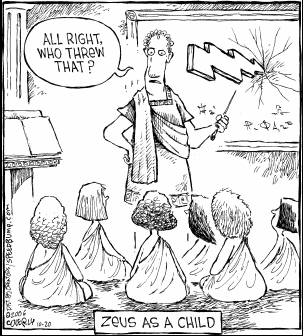
[this cartoon is care of rogue classicum]

Here are two interesting posts (from laudator temporis acti) on the face that launched a thousand ships and 1001 books to read before you die.