Monday, December 18, 2006

On this day...

Today is the anniversary of the Battle of Trebia, the first major battle fought by Hannibal against the Romans in the Second Punic War. Hannibal had crossed the Alps from Spain into Italy with an army of some 40 000 men, and Tiberius Sempronius Longus (eager for battle with an election approaching) foolishly walked his larger army straight into an ambush. Here is Livy’s account of the battle:

Sempronius ad tumultum Numidarum primum omnem equitatum, ferox ea parte virium, deinde sex milia peditum, postremo omnes copias ad destinatum iam ante consilio avidus certaminis eduxit.

Sempronius, eager for the contest, as soon as battle was provoked by the Numidians, led out all the cavalry, being full of confidence in that part of the forces; then six thousand infantry, and lastly all his army, to the place already determined in his plan.

erat forte brumae tempus et nivalis dies in locis Alpibus Appenninoque interiectis, propinquitate etiam fluminum ac paludum praegelidis. ad hoc raptim eductis hominibus atque equis, non capto ante cibo, non ope ulla ad arcendum frigus adhibita, nihil caloris inerat, et quidquid aurae fluminis appropinquabant, adflabat acrior frigoris vis.

It happened to be the winter season and a snowy day, in the region which lies between the Alps and the Apennine, and excessively cold by the proximity of rivers and marshes: besides, there was no heat in the bodies of the men and horses thus hastily led out without having first taken food, or employed any means to keep off the cold; and the nearer they approached to the blasts from the river, a keener degree of cold blew upon them.

ut vero refugientes Numidas insequentes aquam ingressi sunt—et erat pectoribus tenus aucta nocturno imbri—tum utique egressis rigere omnibus corpora ut vix armorum tenendorum potentia esset, et simul lassitudine et procedente iam die fame etiam deficere.

But when, in pursuit of the flying Numidians, they entered the water, (and it was swollen by rain in the night as high as their breasts,) then in truth the bodies of all, on landing, were so benumbed, that they were scarcely able to hold their arms; and as the day advanced they began to grow faint, both from fatigue and hunger.

Hannibalis interim miles ignibus ante tentoria factis oleoque per manipulos, ut mollirent artus, misso et cibo per otium capto, ubi transgressos flumen hostes nuntiatum est, alacer animis corporibusque arma capit atque in aciem procedit…

In the mean time the soldiers of Hannibal, fires having been kindled before the tents, and oil sent through the companies to soften their limbs, and their food having been taken at leisure, as soon as it was announced that the enemy had passed the river, seized their arms with vigour of mind and body, and advanced to the battle…

pedestris pugna par animis magis quam viribus erat, quas recentes Poenus paulo ante curatis corporibus in proelium attulerat; contra ieiuna fessaque corpora Romanis et rigentia gelu torpebant. restitissent tamen animis, si cum pedite solum foret pugnatum; sed et Baliares pulso equite iaculabantur in latera et elephanti iam in mediam peditum aciem sese tulerant et Mago Numidaeque, simul latebras eorum improvida praeterlata acies est, exorti ab tergo ingentem tumultum ac terrorem fecere.

The battle between the infantry was equal rather in courage than strength; for the Carthaginian brought the latter entire to the action, having a little before refreshed themselves, while, on the contrary, the bodies of the Romans, suffering from fasting and fatigue, and stiff with cold, were quite benumbed. They would have made a stand, however, by dint of courage, if they had only had to fight with the infantry. But the Baliares, having beaten off the cavalry, poured spears on their flanks, and the elephants had already penetrated to the centre of the line of the infantry; while Mago and the Numidians, as soon as the army had passed their place of ambush without observing them, starting up on their rear, occasioned great disorder and alarm.

Livy XXI, 54-55.

Wednesday, December 13, 2006

Which Roman Goddess Are You?

i. What’s your favourite animal?
(a) peacock
(b) dove
(c) owl
(d) deer

ii. What’s your favourite tree?
(a) pomegranate
(b) myrtle
(c) olive
(d) cypress

iii. Where would you most like to go on holidays?
(a) Carthage, in Africa
(b) Cyprus, in Greece
(c) Athens, in Greece
(d) Ephesus, in Turkey

iv. What’s your ideal way to spend a Saturday night?
(a) tormenting my step-children
(b) spending some quality time with my boyfriend
(c) staying at home, doing some weaving or sewing
(d) running through the woods with my hunting dogs

v. Your friends say you are:
(a) strong and powerful
(b) beautiful and sensitive
(c) beautiful and serious
(d) fun-loving and adventurous

vi. Tell me about your parents:
(a) My father Cronos, swallowed me when I was born, but my brother gave him poison to make him vomit me back up
(b) I was born from the waves which washed around the severed limbs of Uranus
(c) I was born, fully grown, from the head of my father Jupiter, who had swallowed my mother
(d) I am the daughter of Jupiter and Latona, born on the sacred Island of Delos

vii. You’ve been offended by a pesky mortal. How do you take revenge?
(a) send a huge storm to shipwreck him at sea
(b) make her fall in love with the ugliest man alive
(c) turn her into a spider
(d) turn him into a deer, and make his own hunting dogs tear him to pieces

[to find out which Roman goddess you are see comments]

[for a similar (but better) quiz visit this site]

Friday, December 08, 2006

Ovid's Umbrella

I’ve just finished reading a book called Milton’s Teeth and Ovid’s Umbrella, a history of everyday artefacts, and what they can tell us about life in times past. It’s really easy to read, full of quirky facts and interesting insights, including chapters on taxes, toothbrushes, football, chess, tools and lawns. Here’s an extract from his chapter on umbrellas:

“Umbrella comes from the Latin umbra, meaning shadow, and the diminutive suffix –ulum, meaning little. The resulting umbraculum or “little shadow” signified a sunshade or parasol.

Ovid said that Hercules held a golden
umbraculum to keep the sun off his beloved Omphale, the princess of Lydia. And the epigrammatist Martial elevated the umbrella to a work of art in one of his bright two-liners. He saw the umbraculum as Everyman’s personal awning, even when the wind was up. Which only goes to show that Martial never tried to manoeuvre one through a city downpour...

In Egyptian art the pharaoh’s umbrella is common, and both Assyrian and Persian bas-relief sculptures from Ninevah and Persepolis show the monarch protected by an umbrella. Again the common sunlight that falls on us all must not descend on royalty as well.

So umbrellas had to do with power. No wonder they came to be the essential accoutrement of the British power broker, the businessman. And even as his empire waned, his symbols- brolly and bowler- remained.

But this was nothing new, even for earlier empires. The Roman emperor Heliogabalus adopted the umbrella as the symbol of his reign (A.D. 218-222). Indeed there is plenty of evidence that he identified himself with the sun god, hence the
helios in his name. On his coins and in his art, the point of umbrella was that he too radiated power.”

Tuesday, December 05, 2006

The wrong man

I came across a review of an interesting-looking movie the other day, called ‘The Wrong Man’ (or ‘Lucky Number Slevin’ in the US). What caught my eye was that the main character (who from what I could tell from the review is mistaken for someone else and gets caught in a tricky situation) claims to have ‘ataraxia syndrome’. I’m not sure if this is a real syndrome, but in the movie (which I admit I haven't seen) it has the effect that the main character remains cool and level-headed despite the most worrying circumstances.

This idea comes from the Greek word ataraxia (often translated as ‘pleasure’, but meaning something closer to ‘serenity’), which was a central concept in Epicurean Philosophy. Epicureans are often stereotyped as being debauched, gluttonous hedonists, but in fact this is an unfair caricature.

Epicureans did indeed believe that pleasure was the highest good (summum bonum) in life, but they had a different understanding of pleasure to what we might understand today. For an Epicurean true pleasure is freedom from the pain of need or desire. True pleasures are those which satisfy the body’s needs, without developing an appetite that cannot be sustained. For example, a simple meal of bread is a more satisfying than a rich banquet, as when the banquet is over it causes pain by its absence. Likewise romantic attachments are to be avoided because of the pain they would cause if they were to end. “The apparent ‘cultivation’ of pleasure in this way only serves to diminish it, whereas the wise man (sic) will remain content with what is easily available… and will not develop appetites that cannot be satisfied… The man (sic) who can find pleasure in simple things will always be satisfied, and the fastidious bon viveur will have less pleasure and more pain than the humblest of the poor.”*

This kind of pleasure - a freedom from want and worry - is what Epicurus termed ataraxia.

* Introduction to Lucretius, On the Nature of the Universe, Penguin Classics, pp. xix-xx.

HSC Marking

Last month I was involved in marking the Latin HSC exams, something I hadn’t done before. It was a pretty tiring experience, but very valuable. Here are five things I learnt from HSC marking:

  • markers will do their very best to give students as many marks as they possibly can. You can get things wrong, and still get full marks, even in questions that seem to have a definite answer (such as scansion questions).

  • the Latin exam is as much a test of how well you understand the question you are being asked, as of how well you understand the texts you have studied throughout the year.

  • all students find unseen translation difficult, but the marking guidelines take that into account.

  • big words do not impress markers; if you are going to use a big word, make sure you know what it means, and how it relates to the question.

  • Latin students around NSW are obsessed with alliteration.

Monday, December 04, 2006

Target

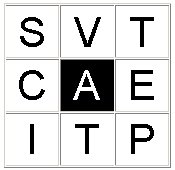
Here's a target puzzle I set for my year nine class the other day. See how many words you can get:


Solving the Target Puzzles

See how many Latin words of two letters or more you can make from the letters shown in the above grid.

In making a word, each letter must be used once only.

Each word must contain the centre letter and there must be at least one nine-letter word in the list.

You may include words of any case, number, tense, mood, voice or person, but only one form of each word.

[I managed to make about 30 words, though that is by no means definitive. I'll put up my list in a couple of days, if anyone's interested]