Tuesday, February 24, 2009

Warren Buffet, Horace and Ovid

I was reading something a couple of weeks ago (though I can't for the life of me remember what), and came across a quote from Warren Buffet (currently the world's richest person) that stuck in my head. He said something along the lines of that he had made so much money by being cautious when everyone else is greedy, and by being greedy when everyone else is cautious. Good on him.

A few days later I happened to be reading a Horace poem which contains a similar idea:

auream quisquis mediocritatem
diligit, tutus caret obsoletis
ordibus tecti, caret invidenda
sobrius aula.

saepius ventis agitatur ingens

pinus et celsae graviore casu
decidunt turres feriuntque summos
fulgura montis.

sperat infestis, metuit secundis
alteram sortem bene praeparatum
pectus.

Whoever cherishes the golden middle-way
will safely avoid the squalor of the slums
and will soberly avoid the palace
which brings only jealousy.

Often a huge pine tree is uprooted by the winds,
and tall towers fall with more serious
consequences, and lightning strikes
the highest mountains.

When times are tough, the well prepared heart
hopes for a change of fate, and, when they are favourable,
fears it.
(Horace, Odes II.10)

The idea of the 'golden middle-way' (auream... mediocritatem) was particularly dear to the Romans (especially Stoics), who took the story of Daedalus and Icarus as a kind of parable on the dangers of excess:

instruit et natum 'medio' que 'ut limite curras,
Icare,' ait 'moneo, ne, si demissior ibis,
unda gravet pennas, si celsior, ignis adurat...
me duce carpe viam!'

He fitted his son with the wings and said to him 'I warn you, Icarus, to fly on the middle course, so that, if you fly too low, the waves won't weigh down your wings, nor, if you fly too high, will the sun's fire burn them... With me as your leader, take to the sky!

(Ovid, Metamorphoses VIII.203ff)
Related Posts
liber faciei

Someone very clever has made a mock facebook page for the Aeneid. Check it out.

(Thanks to eternally cool for bringing it to my attention)

Friday, February 20, 2009

Mount Soracte

Horace's Ode I.9 (a translation of which you can find here or here) opens with the poet observing the effects of winter all around him and urging his (probably imaginary) friend to build up a nice big fire and get out the wine.

Vides ut alta stet nive candidum
Soracte nec iam sustineant onus
silvae laborantes geluque
flumina constiterint acuto?

Dissolve frigus ligna super foco 5

large reponens atque benignius
deprome quadrimum Sabina,
o Thaliarche, merum diota.

See how Soracte stands deep
in dazzling snow and the trees cannot bear
their loads and bitter frosts
have paralysed the streams?

Dispel the cold, heap plentiful logs
on the hearth and draw out
your four-year old Sabine wine
from its two handled jugs, Thaliarchus.

This is what Nisbett and Hubbard have to say about Mt Soracte in their commentary on Book I of Horace's Odes:

Mount Soratte is sometimes visible from a few favoured parts of Rome, and the modern tourist, as he (sic) surveys the horizon from the Gianiculo on a clear day willingly imagines that he is re-creating the poet's experience. But we should not suppose that Horace saw the mountain twenty miles away on a winter evening through the narrow slit of an ancient window; he is simply giving local colour to a Greek theme... Horace is not describing a particular scene; rather he has composed a picturesque Christmas-card, based on Alcaeus, and containing among more conventional elements a single feature of familiar topography.

Mount Soratte, 2,400 feet high, [is] about 20 miles north of Rome... At different times it has been called Monte S. Silvestro (after Pope Sylvester I who hid there during the reign of Constantine), or Treste, or Sant'Oreste. It is visible from the
Gianiculo and the Pincio, some tall buildings in Rome, much of the Campagna, and Tivoli (though not, of course, from Horace's Sabine farm). It was associated with Apollo, with the fire-walking Hirpini, with Soranus and Feronia and the cult of the dead (Virg. Aen. 11.785 with Servius, Str. 5.2.9). Some scholars suppose that it has been introduced here becauses of it's funereal associations... but so melancholy a note would be inappropriate at this place in the poem, There is no evidence that the mountain was so sinister that every mention of it suggested thoughts of mortality.

Saturday, February 14, 2009

templum Veneris


Last weekend I read, just for fun, The Knight's Tale from Chaucer's Canterbury Tales. The description of the temple of Venus there struck me, and I thought it would make a fitting post for Valentine's Day.
...in the temple of Venus you might have seen, created upon the wall, in imagery piteous to behold, the broken sleeps and cold sighs, the sacred tears and lamentations, the fiery pangs of desire that love's servants endure in this life... Pleasure and Hope, Desire and Foolhardiness, Beauty and Youth, Mirth, Riches, Love-charms and Violence, Deceits, Flattery, Extravagance, Anxiety and Jealousy... were painted by order upon the wall, and more than I can make mention of.

In truth all the mount of Citheron, where Venus has her principal dwelling, was drawn upon the wall, with all the garden and the lustiness of it. Idleness, the porter, was not forgotten, nor Narcissus the fair of long ago, nor the folly of King Solomon, nor yet the great strength of Hercules; the enchantments of Medea and Circe, nor the hardy fierce heart of Turnus, nor the rich Croesus, captive and in servitude. Thus may you see that neither wisdom nor riches, beauty nor cunning, strength nor hardihood can hold rivalry with Venus, for she can guide all the world as she wish. Lo, all these folk were so caught in her snare until for woe they cried often "Alas!" One or two examples shall suffice here, though I could explain a thousand more.

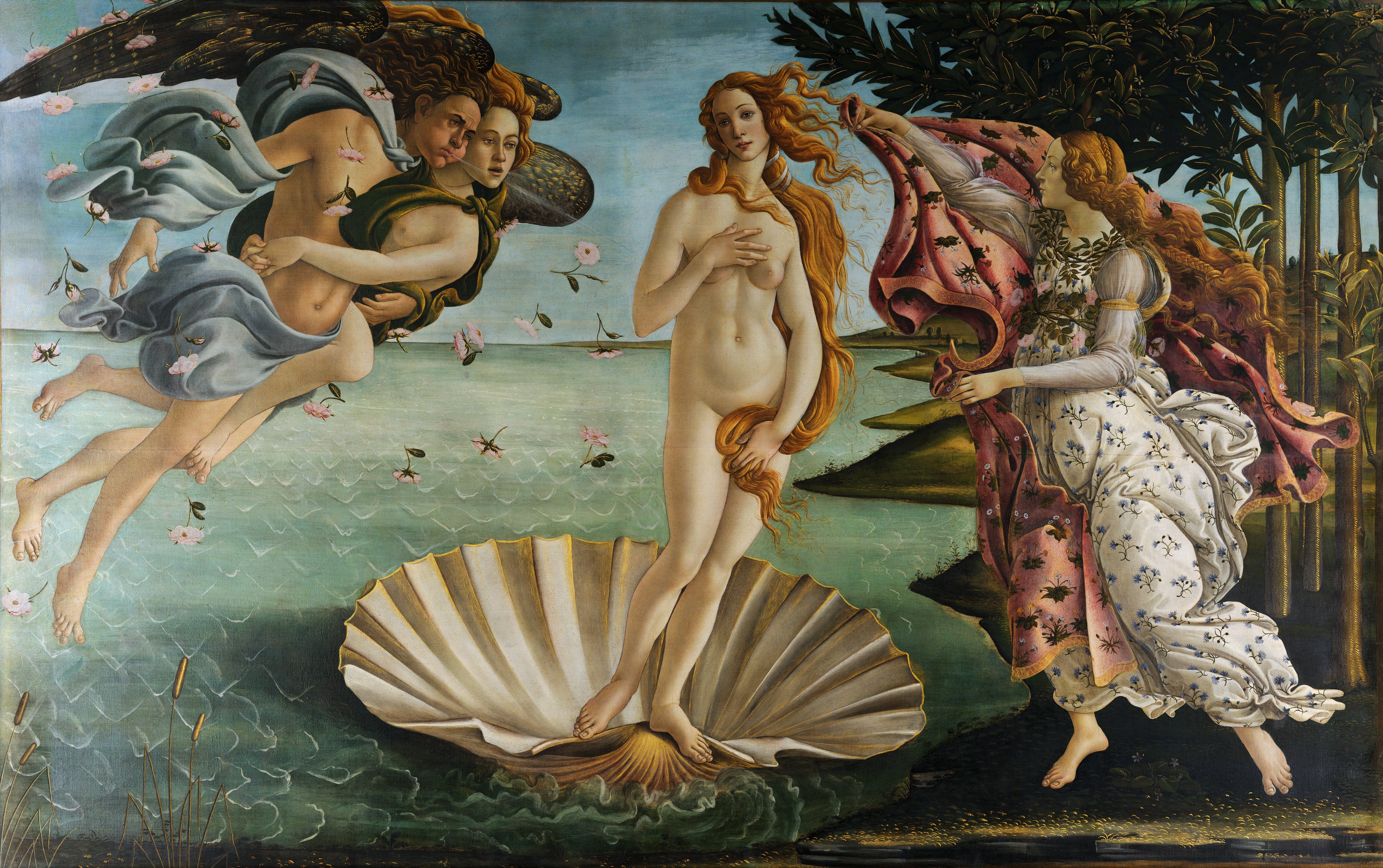
The naked statue of Venus, glorious to look upon, was floating in a great sea, and from the navel down all was covered with green waves, bright as any glass. She had a lyre in her right and, and on her head a rose-garland, fresh and fragrant, and seemly to see. Above her head fluttered her doves, and before her stood her son Cupid, blindfolded, as he is often shown, with two wings upon his shoulders. He carried a bow and bright, keen arrows.

While we're on the subject of Valentine's Day, why not visit these sites and read a bit about about Lupercalia, and why it has nothing to do with Valentine's Day
Related Posts

Thursday, February 12, 2009

Caesar and the Pirates

Since I mentioned pirates in my last post, I thought I'd continue the theme with a story told by Suetonius (among others) about Julius Caesar's encounter with pirates as a young man.

huc dum hibernis iam mensibus traicit, circa Pharmacussam insulam a praedonibus captus est mansitque apud eos non sine summa indignatione prope quadraginta dies cum uno medico et cubicularis duobus. nam comites servosque ceteros initio statim ad expediendas pecunias, quibus redimeretur, dimiserat. numeratis deinde quinquaginta talentis expositus in litore non distulit quin e vestigio classe deducta persequeretur abeuntis ac redactos in potestatem supplicio, quod saepe illis minatus inter iocum fuerat, adficeret... Sed et in ulciscendo natura lenissimus piratas, a quibus captus est, cum in dicionem redegisset, quoniam suffixurum se cruci ante iuraverat, iugulari prius iussit, deinde suffigi.

While crossing to Rhodes, after the winter season had already begun, he was taken by pirates near the island of Pharmacussa and remained in their custody for nearly forty days in a state of intense vexation, attended only by a single physician and two body-servants; for he had immediatley sent off his travelling companions and the rest of his attendants, to raise money for his ransom. Once he was set on shore on payment of fifty talents, he did not delay then and there to launch a fleet and pursue the departing pirates, and the moment they were in his power to inflict on them the punishment which he had often threatened when joking with them... Even in avenging wrongs he was by nature most merciful, and when he got hold of the pirates who had captured him, he had them crucified, since he had sworn beforehand that he would do so, but ordered that their throats be cut first.

(Suetonius, Divus Iulius 4, 74)
The ransom of fifty talents mentioned by Suetonius was originally, according to Plutarch, set at twenty:

To begin with, then, when the pirates demanded twenty talents for his ransom, he laughed at them for not knowing who their captive was, and of his own accord agreed to give them fifty.
Plutarch also elaborates on the threats and jokes mentioned by Suetonius:
For eight and thirty days, as if the men were not his watchers, but his royal body-guard, he shared in their sports and exercises with great unconcern. He also wrote poems and sundry speeches which he read aloud to them, and those who did not admire these he would call to their faces illiterate Barbarians, and often laughingly threatened to hang them all. The pirates were delighted at this, and attributed his boldness of speech to a certain simplicity and boyish mirth. But after his ransom had come from Miletus and he had paid it and was set free, he immediately manned vessels and put to sea from the harbour of Miletus against the robbers. He caught them, too... and crucified them all, just as he had often warned them on the island that he would do, when they thought he was joking.
(Plutarch, Life of Caesar 2)

Related Post

Tuesday, February 10, 2009

Myoparones

Translating Cicero’s In Verrem V with my year 12 class recently, we came across an unusual Latin word. Verres had been accused (among many other things) of accepting a bribe to release a pirate, and keeping the plunder for himself and his cronies, and Cicero, in summing up his behaviour, writes:

Haec igitur est gesta res, haec victoria praeclara: myoparone piratico capto dux liberatus, symphoniaci Romam missi, formosi homines et adulescentes et artifices domum abducti, in eorum locum et ad eorum numerum cives Romani hostilem in modum cruciati et necati...

And so this is what he accomplished, this outstanding victory: having captured a pirate myoparo, the leader was set free, the musicians who had been on board were sent to Rome, as for the pirates’ captives, the good-looking ones, the young ones those with any kind of skill were taken away to his home, and in place of the pirates whom he had set free, and to make up their number, Roman citizens were tortured and killed as if they were enemies…

The unusual word here is myoparo, in the first line; it seems to refer to some kind of pirate ship, but what kind of ship exactly? Levens has this to say:

myoparone: this word, which is used later in the speech (§§89, 97, 100), to describe other pirate ships, was a grammarians’ puzzle until the discovery in Tunisia [i.e. the Ancient city of Carthage] of a mosaic depicting various types of a ship with their names attached… There a myoparo is shown between a vessel called mydion or musculus (Gr. and Lat. diminutives of mus, which in both languages, means a rat or mouse) and another called paro, so we suppose it to be a portmanteau word denoting a ship combining the characteristics of these two types. The first half of the compound suggests that the myoparo was small (cf. §§89; 97) and fast-moving (in the mosaic it has both mast and oars), as pirate ships would need to be…

R. G. C. Levens, Cicero; The Fifth Verrine Oration

I tried to locate a picture of the mosaic referred to by Levens, but the best I could find was at this site. Here are two other discussions of what kind of ship this actually was:

As a rule we do not find that the pirates made use of any particular rig or build. Probably, in most cases the would-be pirate was content with the first boat that came to hand by theft or purchase… The two vessels which in Hellenistic and Roman times are most closely associated with the pirates, the hemiolia and the myoparo, were [also] widely used by others… The myoparo, according to Mr Torr was broader than the regular warship in proportion to its length, and, we may assume, more suitable for stowing loot. Both vessels were sea-going ships, the myoparo, at any rate, possessing a mast and sails, as well as oars.

[Myoparones] were fighting ships of no great size. They were in use throughout the Mediterranean in the First Century B.C. for warfare and for piracy. Apparently they were broader than the regular war-ships in proportion to their length, and therefore better able to keep the sea. [The evidence of Appian and Plutarch] would naturally define the myoparones as vessels of a hybrid species between the long ships and the round ships… vessels termed parones and parunculi are mentioned in verses that are ascribed to Cicero…. The myoparones therefore bore a compound name: and a compound name would naturally be given to a ship of an intermediate type.

C. Torr, Ancient Ships