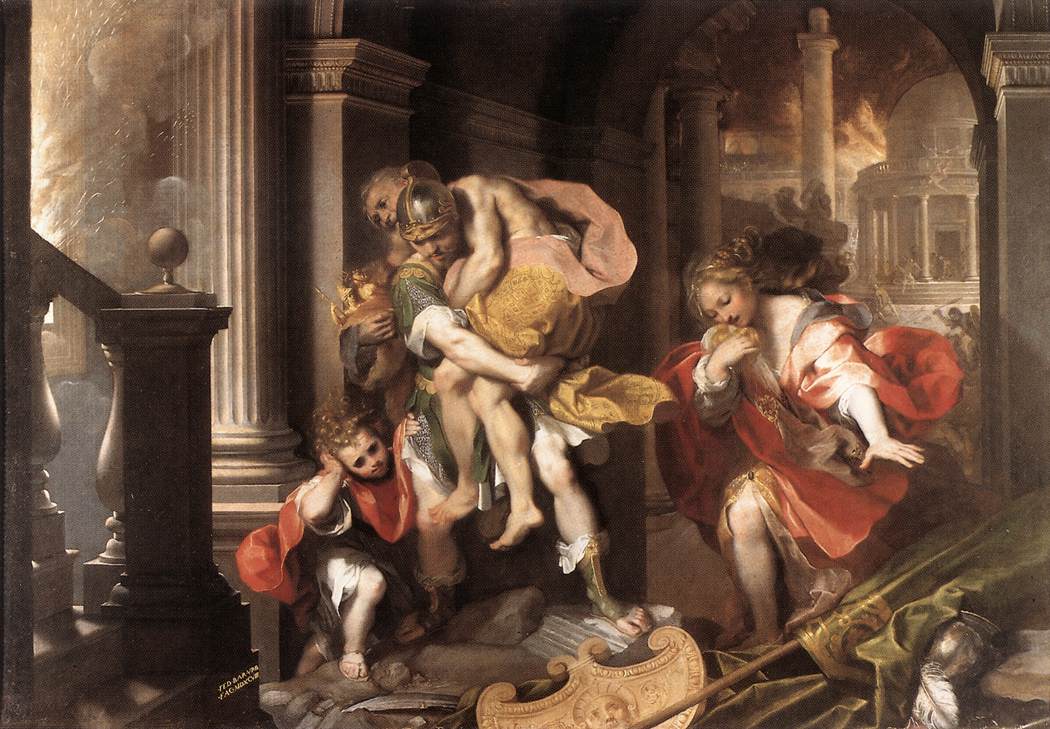
Aeneid I.92-101
extemplo Aeneae solvuntur frigore membra:
ingemit, et duplicis tendens ad sidera palmas
talia voce refert: 'o terque quaterque beati,
quis ante ora patrum Troiae sub moenibus altis
contigit oppetere! o Danaum fortissime gentis
Tydide! mene Iliacis occumbere campis
non potuisse, tuaque animam hanc effundere dextra,
saevus ubi Aeacidae telo iacet Hector, ubi ingens
Sarpedon, ubi tot Simois correpta sub undis
scuta virum galeasque et fortia corpora volvit?'
Immediately Aeneas’ limbs grow weak with cold: he groans, and stretching both hands to the stars cries out in with these words: “O three and four times blessed, you who were permitted to die before the faces of your fathers, beneath the lofty walls of Troy! O Diomedes, bravest of the race of Greeks! Why could I not have perished on the Trojan plain, and have poured out my life at your right hand, where fierce Hector lies by the spear of Achilles, where great Sarpedon, where the river Simois rolls and carries beneath its waves the helmets and shields and brave bodies of men.
This is Aeneas’ first appearance in the Aeneid, and we see once again a strong similarity to the work of Homer. Aeneas and his crew are caught in a storm stirred up against them by the goddess Juno, in a scene similar to one in Homer’s Odyssey. There Odysseus cries out “Thrice happy and more were those among the Greeks who long ago perished in the wide land of Troy to do the will of the sons of Atreus! If only I too had died, and had met my doom on the day when the thronging Trojans hurled their bronze-pointed spears against me in the battle round the dead son of Peleus.”
What both Odysseus and Aeneas here express is more than just dissatisfaction with their present sufferings- it reflects a particularly Homeric ideal of heroism. It is not simply death that each cries out for, but a glorious, heroic death in battle. This is the kind of heroism typical of Achilles, who was told that he could choose between a long but dull life and a glorious but brief life. For Achilles the desire for glory outweighed that for life, hence his involvement in the Trojan War.
This kind of heroism is also seen throughout the Aeneid, though never in a positive light. It is the kind of heroism displayed by King Priam, who tries heroically but pointlessly to fight Pyrrhus, by Nisus and Euryalus who attack their enemy’s camp at night, but fail to get a message through to Aeneas, and by Aeneas himself when he is told by Hector to flee the burning city of Troy, but instead rushes madly through the city until his mother Venus appears to him, and urges him to save himself and his family.
In the Aeneid we see a new definition of what it means to be heroic- to be pius, to have pietas. To be pius has religious connotations, but it involves more than just piety. It involves a feeling of duty towards the gods, the state and one's family. In English it is a difficult concept to translate, but ‘dutiful’ perhaps comes closest the Roman idea. pius is the adjective most commonly used to describe Aeneas in the Aeneid, and his pietas is seen most prominently in his submission to the will of the gods, especially at personal cost (i.e. leaving Dido in book IV) and in his rescue of his family from the ruins of Troy. He does not always display such pietas- in many ways he is a flawed hero- but it is this quality which Virgil holds up as the ideal for his hero, and into which Aeneas grows over the course of the Aeneid.
Friday, September 29, 2006

Thursday, September 28, 2006
The Lost Echo
Last night I went to see part one of The Lost Echo, Barry Kosky’s eight-hour stage adaptation of Ovid’s Metamorphoses. It’s an amazing production- ranging from the simplicity of a lone actor sitting on stage, telling the story of Phaethon, to a Scottish performance poet telling the story of the transformation of Teiresias in a crowded pub, to an all singing, all dancing Las Vegas-style chorus line lamenting the rape of Philomela, with a giant penguin thrown in along the way for good measure. The first Act was a collection of myths based around Diana (Callisto, Endymion, Actaeon), with Diana and her virgin followers portrayed as giggly private school girls and Pan and his followers as loutish college boys. The second was a much darker collection, dealing with greed, lust and violence (Erysichthon, Hermaphroditus, Arachne, Myrrha) culminating in the incredibly powerful story of the rape of Philomela, told in sign language, as her tongue had been torn out to preventing her revealing the crime committed against her.
It’s quite a confronting play, but also surprisingly funny. At times it’s pretty sexually graphic, and the violence and lust of the second half is quite disturbing, but I think it captures a lot of Ovid’s original. Ovid wrote his collection of myths in highly irreverent, sexually charged and exaggeratedly violent poetry, as an exercise in extravagant story-telling, and The Lost Echo reflects that really well.
You can read more here, here and here.
It’s quite a confronting play, but also surprisingly funny. At times it’s pretty sexually graphic, and the violence and lust of the second half is quite disturbing, but I think it captures a lot of Ovid’s original. Ovid wrote his collection of myths in highly irreverent, sexually charged and exaggeratedly violent poetry, as an exercise in extravagant story-telling, and The Lost Echo reflects that really well.
You can read more here, here and here.
Monday, September 25, 2006
Aeneid part I- A New Kind of Epic
My year 11 class are doing an introduction to the Aeneid at the moment. We'll be translating ten short passages from the Aeneid, and looking at what they tell us about its story and themes. As we go through each passage I'll post it here, along with a translation and a short discussion of what makes it an important passage. Here's the first instalment.
Aeneid I.1-7
arma virumque cano, Troiae qui primus ab oris
Italiam, fato profugus, Laviniaque venit
litora, multum ille et terris iactatus et alto
vi superum saevae memorem Iunonis ob iram;
multa quoque et bello passus, dum conderet urbem,
inferretque deos Latio, genus unde Latinum,
Albanique patres, atque altae moenia Romae.
I sing of battles, and of the man who first came from the shores of Troy, an exile of fate, to Italy and the shores of Lavinia, greatly harassed on land and sea by the power of the gods, for the sake of the unforgetting anger of Juno; many things he suffered too in war, before he could at last establish a city, and bring his gods to Latium, from whence comes the Latin race, the Alban fathers and the walls of lofty Rome.
Virgil’s Aeneid is essentially the story of a man (virum)- Aeneas, a Trojan prince who leads a band of survivors from the ruined city of Troy to a new homeland in Italy. This was a story that was well known to the Romans and had been told before by the Roman poets Naevius and Ennius. The story of the Trojan War had of course also been told by Homer from the Greek perspective in the Iliad and the Odyssey. In fact, Virgil in his first two words deliberately refers to Homer’s poems. Broadly speaking the Iliad is a poem about battle, and the Odyssey about a man- Odysseus. In fact the first word of the Odyssey is 'ανερ' (aner, man), echoed in sound by arma, and in meaning by virum. Virgil’s point is that his poem is in the same tradition of epic poetry as Homer, dealing with the same themes (wars, gods, heroes). Indeed much of the material in the Aeneid is based on Homer’s poetry, and the Aeneid is often broken into two halves; the story of Aeneas' journey in books I-VI (Virgil’s Odyssey) and the story of the battles he must fight when he reaches Italy in books VII-XII (Virgil’s Iliad). But in this passage Virgil also introduces a new element, something that sets his poem apart from those of Homer: Romae- left til the end of the sentence for emphasis and dramatic effect. Virgil’s poem is not only the story of war and heroes, it is also about Roman identity, morality and destiny. The Aeneid is in a sense Roman propaganda- written in a time when Rome was just emerging from decades of civil war it is a reflection on what made Rome great, and a vision of what Virgil hopes she (and her ruler, Augustus) may become.
Aeneid I.1-7
arma virumque cano, Troiae qui primus ab oris
Italiam, fato profugus, Laviniaque venit
litora, multum ille et terris iactatus et alto
vi superum saevae memorem Iunonis ob iram;
multa quoque et bello passus, dum conderet urbem,
inferretque deos Latio, genus unde Latinum,
Albanique patres, atque altae moenia Romae.
I sing of battles, and of the man who first came from the shores of Troy, an exile of fate, to Italy and the shores of Lavinia, greatly harassed on land and sea by the power of the gods, for the sake of the unforgetting anger of Juno; many things he suffered too in war, before he could at last establish a city, and bring his gods to Latium, from whence comes the Latin race, the Alban fathers and the walls of lofty Rome.
Virgil’s Aeneid is essentially the story of a man (virum)- Aeneas, a Trojan prince who leads a band of survivors from the ruined city of Troy to a new homeland in Italy. This was a story that was well known to the Romans and had been told before by the Roman poets Naevius and Ennius. The story of the Trojan War had of course also been told by Homer from the Greek perspective in the Iliad and the Odyssey. In fact, Virgil in his first two words deliberately refers to Homer’s poems. Broadly speaking the Iliad is a poem about battle, and the Odyssey about a man- Odysseus. In fact the first word of the Odyssey is 'ανερ' (aner, man), echoed in sound by arma, and in meaning by virum. Virgil’s point is that his poem is in the same tradition of epic poetry as Homer, dealing with the same themes (wars, gods, heroes). Indeed much of the material in the Aeneid is based on Homer’s poetry, and the Aeneid is often broken into two halves; the story of Aeneas' journey in books I-VI (Virgil’s Odyssey) and the story of the battles he must fight when he reaches Italy in books VII-XII (Virgil’s Iliad). But in this passage Virgil also introduces a new element, something that sets his poem apart from those of Homer: Romae- left til the end of the sentence for emphasis and dramatic effect. Virgil’s poem is not only the story of war and heroes, it is also about Roman identity, morality and destiny. The Aeneid is in a sense Roman propaganda- written in a time when Rome was just emerging from decades of civil war it is a reflection on what made Rome great, and a vision of what Virgil hopes she (and her ruler, Augustus) may become.
Wednesday, September 20, 2006
Love and Hate in Ancient Rome
Here's a special guest post from my fabulous year 10 class
Catullus was a well-known Roman poet who composed influential poems of life, love and sarcasm. Little wonder our year 10 Latin class had never heard of him before. But we were soon to discover that the themes and ideas he wrote about in the 1st century B.C. are still prominent in today’s popular culture.
But what are these themes you might ask? Well, there’s a wide range, from utter love and devotion to depression heartbreak and tears. At many times it seemed like the latter outweighed the former, as in this line:
nunc iam illa non vult: tu quoque impotens noli…
“Now she doesn’t want you anymore, and you, powerless, don’t want her either…”
(Catullus, Carmen 8)
It was lines like these which inspired year 10 Latin’s presentations, and the overuse of the word ‘emo’. By the end of our presentations all of us were slightly more enlightened, and we realised that the themes and emotions expressed by Catullus were also present in many of our favourite songs, books TV shows, and movies. Everything from Pride and Prejudice by Jane Austen, to the films Titanic, Sweet Home Alabama and The Princess Diaries, to the songs You’re beautiful by James Blunt and Addicted by Kelly Clarkson- Catullus did it all.
We’ll leave you now with a poem which we all think sums Catullus up; Odi et amo (I hate and I love):
Odi et amo. quare id faciam, fortasse requires?
nescio, sed fieri sentio, et excrucior.
“I hate and I love. Why do I do this perhaps you ask?
I don’t know, but I feel it happening and am tortured.”
(Catullus, Carmen 85)
By Jade, Rebecca and Milunka, year 10 Latin.
[For more on Catullus see these previous posts]
Catullus was a well-known Roman poet who composed influential poems of life, love and sarcasm. Little wonder our year 10 Latin class had never heard of him before. But we were soon to discover that the themes and ideas he wrote about in the 1st century B.C. are still prominent in today’s popular culture.
But what are these themes you might ask? Well, there’s a wide range, from utter love and devotion to depression heartbreak and tears. At many times it seemed like the latter outweighed the former, as in this line:
nunc iam illa non vult: tu quoque impotens noli…
“Now she doesn’t want you anymore, and you, powerless, don’t want her either…”
(Catullus, Carmen 8)
It was lines like these which inspired year 10 Latin’s presentations, and the overuse of the word ‘emo’. By the end of our presentations all of us were slightly more enlightened, and we realised that the themes and emotions expressed by Catullus were also present in many of our favourite songs, books TV shows, and movies. Everything from Pride and Prejudice by Jane Austen, to the films Titanic, Sweet Home Alabama and The Princess Diaries, to the songs You’re beautiful by James Blunt and Addicted by Kelly Clarkson- Catullus did it all.
We’ll leave you now with a poem which we all think sums Catullus up; Odi et amo (I hate and I love):
Odi et amo. quare id faciam, fortasse requires?
nescio, sed fieri sentio, et excrucior.
“I hate and I love. Why do I do this perhaps you ask?
I don’t know, but I feel it happening and am tortured.”
(Catullus, Carmen 85)
By Jade, Rebecca and Milunka, year 10 Latin.
[For more on Catullus see these previous posts]
Tuesday, September 19, 2006
castra latina
Over the weekend I had the wonderful privilege of going to Latin camp with eight of my best and brightest year eight students. It was a fun time, and I even learnt something. Here are three things I learnt on Latin camp.
- To cure a toothache, a Roman would take a bite out of a tree which had been struck by lightning, with his hands tied behind his back.
- The Romans found that one of the most effective ways to deal with the Carthaginian army's battle elephants was to get a pig, point it in the direction of the enemy lines, pour oil on it and set it alight. Nothing scares an elephant like a squealing flaming pig, apparently.
- A Roman century had only 80 soldiers in it, not 100 as you would expect (centum= 100). Originally a century did comprise of 100 soldiers, but when Marius reformed the Roman army he made the soldiers carry all their own equipment. There was no room in the tents for the extra equipment, so instead of making bigger tents, they kicked two guys out of each one, meaning that there were eight (rather than ten) men in each tent. The number of tents per century remained constant, and so a century was reduced from 100 to 80 soldiers.
The last two facts come courtesy of the remarkable James Adams.
Monday, September 18, 2006
arma virumque cano...
Virgil’s Aeneid is one of the most important works of Latin literature, and one which we will be studying for our year 12 course next year. Unfortunately, we will only have time to study extracts from one of the 12 books (book 8), but it’s important to have an understanding of the structure and themes of the work as a whole, to give us a context for the sections we will be reading.
Read about the Aeneid on these sites, then make some notes on the questions which follow.
- What is epic poetry?
- What is the basic plot of the Aeneid?
- Who are some of the important characters in the Aeneid?
- Why did Virgil write the Aeneid?
Over the next two weeks we will be reading extracts from different parts of the Aeneid. As you prepare your translations, here are some sites that might help you:
Here you can find the Latin text of the Aeneid. If you click on a word it will give you its meaning, and for some sections it will also provide background and commentary.
Here is an English translation.
Here is a good online dictionary.
Wednesday, September 13, 2006
By Jove...

Today is the 2515th anniversary of the dedication of the temple of Jupiter on the Capitoline Hill. Here are seven things you may not have known about Jupiter.
- His name isn’t really Jupiter- it’s Jove. Jupiter (Iuppiter in Latin) is derived from Iovis pater (father Jove).
- For the Romans he was the god of the sky (hence the thunder and lightening) and therefore the supreme god. He was also the patron god of Rome, and had the job of looking after laws and social order.
- His sacred bird was the eagle, and his favourite tree was the oak (though olive trees were sacred to him as well).
- He was married to Juno, who also happened to be his sister.
- One of his favourite tricks was to transform his appearance, and on different occasions he changed himself into a bull to seduce Europa, a shower of gold to seduce Danae, and a swan to seduce Leda.
- Jupiter had quite a lot of lovers. In fact the moons of the planet Jupiter (of which there are at least 63) have traditionally been named after his lovers, (such as Io, Europa, Ganymede and Callisto) and their descendants.
- The French word for Thursday (Jeudi) is named after Jupiter, coming from the Latin Iovis dies. The word Thursday comes from Thor- the Norse equivalent of Jupiter. In German, Thursday is Donnerstag after the thunder of Thor/Jupiter (donner means thunder, blitzen is lightening).
Tuesday, September 12, 2006
cabbage
I have never much liked cabbage, but Cato, who by all accounts was a sensible guy, thought it was pretty good for you. Here's some of the health benefits he thought you could derive from cabbage:
et hoc amplius lotium conservato eius qui brassicam essitarit, id calfacito, eo hominem demittito, cito sanum facies hac cura (expertum hoc est). item pueros pusillos si laves eo lotio, numquam debiles fient. et quibus oculi parum clari sunt, eo lotio inunguito, plus videbunt. si caput aut cervices dolent, eo lotio caldo lavito, desinent dolere.
De Agri Cultura 157
Heat the urine of a person who eats cabbage habitually, bathe the patient in it. He will be healed quickly (this remedy has been tested). Likewise if you bathe babies in this same urine they will never be sickly, and those with bad eyesight will see better. It also relieves pain in the head or neck.
Personally, I'd rather wear glasses. See here for more of the wonders of cabbage.
et hoc amplius lotium conservato eius qui brassicam essitarit, id calfacito, eo hominem demittito, cito sanum facies hac cura (expertum hoc est). item pueros pusillos si laves eo lotio, numquam debiles fient. et quibus oculi parum clari sunt, eo lotio inunguito, plus videbunt. si caput aut cervices dolent, eo lotio caldo lavito, desinent dolere.
De Agri Cultura 157
Heat the urine of a person who eats cabbage habitually, bathe the patient in it. He will be healed quickly (this remedy has been tested). Likewise if you bathe babies in this same urine they will never be sickly, and those with bad eyesight will see better. It also relieves pain in the head or neck.
Personally, I'd rather wear glasses. See here for more of the wonders of cabbage.
Proverbia
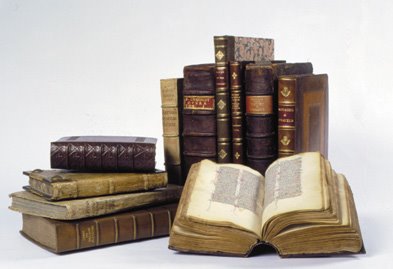
I found a site dedicated to Latin proverbs the other day. Here are three about books:

Optimus magister bonus liber
A good book is the best teacher
Bonus liber amicus optimus
A good book is the best friend
Libri muti magistri sunt
Books are silent teachers
Optimus magister bonus liber
A good book is the best teacher
Bonus liber amicus optimus
A good book is the best friend
Libri muti magistri sunt
Books are silent teachers
Wednesday, September 06, 2006
Your favourite author
My new poll (thanks to all who voted in the last one) is in honour of my year 11 class, who are doing their exams at the moment. The five authors listed are those which we’ve studied during the course of the year. Feel free to vote- if you’re not sure who some of the authors are, here’s a quick bio of each one.
Ovid: a poet who found it hard to take much seriously. If Ovid were around today, he’d be the class clown with a brilliant wit, and would delight particularly in making fun of Catullus. All the girls would like him, but he would probably get a reputation as a bit of a player.
Virgil: Virgil wrote what is probably Rome’s greatest work of literature. He writes in a beautifully concise way, and is capable of evoking vivid images and powerful emotions with the shortest of phrases. If he attended St George Girls’ he would be the teacher’s pet and do Extension 2 English.
Livy: Livy wrote history, and lots of it. 142 books in fact. He, when he wrote, with an idea having been begun, in order to express it, long and complicated sentences, which seem to take forever to get to the point, whatever that was, and which make you forget what he was talking about in the first place, would use. Livy is the kind of guy who asks for another writing booklet before you’ve even finished reading the question.
Cicero: In my opinion Cicero is one of the smartest guys ever. Unfortunately he had a bit of an attitude problem. He would be the kind of guy who never stops telling you how good he is, and would probably dob in his friends for smoking at the train station.
Lucretius: A bit of an enigma, Lucretius wrote a philosophical poem about the nature of the universe. He would have been the quiet guy at school, who grows dreadlocks, goes to uni and takes nine years to do an arts degree. He would probably have enjoyed watching What the bleep do we know.
Catullus: if Catullus were around today, he’d wear a lot of black and would probably look something like this. He was an intense kind of guy, who fell hard for another man’s wife, and wrote a bunch of poems about the agony and the ecstasy of love.
Ovid: a poet who found it hard to take much seriously. If Ovid were around today, he’d be the class clown with a brilliant wit, and would delight particularly in making fun of Catullus. All the girls would like him, but he would probably get a reputation as a bit of a player.
Virgil: Virgil wrote what is probably Rome’s greatest work of literature. He writes in a beautifully concise way, and is capable of evoking vivid images and powerful emotions with the shortest of phrases. If he attended St George Girls’ he would be the teacher’s pet and do Extension 2 English.
Livy: Livy wrote history, and lots of it. 142 books in fact. He, when he wrote, with an idea having been begun, in order to express it, long and complicated sentences, which seem to take forever to get to the point, whatever that was, and which make you forget what he was talking about in the first place, would use. Livy is the kind of guy who asks for another writing booklet before you’ve even finished reading the question.
Cicero: In my opinion Cicero is one of the smartest guys ever. Unfortunately he had a bit of an attitude problem. He would be the kind of guy who never stops telling you how good he is, and would probably dob in his friends for smoking at the train station.
Lucretius: A bit of an enigma, Lucretius wrote a philosophical poem about the nature of the universe. He would have been the quiet guy at school, who grows dreadlocks, goes to uni and takes nine years to do an arts degree. He would probably have enjoyed watching What the bleep do we know.
Catullus: if Catullus were around today, he’d wear a lot of black and would probably look something like this. He was an intense kind of guy, who fell hard for another man’s wife, and wrote a bunch of poems about the agony and the ecstasy of love.
[I realise you can't actually vote for Catullus in the poll, but I thought he was worth including anyway]
Tuesday, September 05, 2006
Latin in disguise
Here are five words which you may be surprised to know come from Latin (or then again, perhaps not):
Coriander [Latin: coriandrum]- I always associate coriander with Thai food, but it turns out the Romans grew and ate it as well. Here's a Roman recipe for olive spread you can try if you feel adventurous.
Nullarbor [Latin: nulla arbor]- I assumed for a long time that Nullarbor was an Aboriginal word, until someone pointed out to me that it comes from the Latin for 'no tree', which seems pretty accurate to me.
Circus [Latin circus]- Some friends of mine have just been to see the cirque du soleil. I wonder if they knew that originally a circus simple meant a circle, but came to be associated with the Circus Maximus- a big horse racing track in Rome which could seat more than a hundred thousand spectators.
Cicada [Latin: cicada]- Who would have thought that those ugly insects, which fascinated me as a child, would have a Latin name. Apparently the Romans used the word for grasshoppers too.
Amanda [Latin: amo, amare]- I think I only know two people called Amanda. I'm sure they would both be fascinated to learn that amanda is the gerundive form of the verb amare (to love), and therefore means 'she who must be loved'.
Coriander [Latin: coriandrum]- I always associate coriander with Thai food, but it turns out the Romans grew and ate it as well. Here's a Roman recipe for olive spread you can try if you feel adventurous.
Nullarbor [Latin: nulla arbor]- I assumed for a long time that Nullarbor was an Aboriginal word, until someone pointed out to me that it comes from the Latin for 'no tree', which seems pretty accurate to me.
Circus [Latin circus]- Some friends of mine have just been to see the cirque du soleil. I wonder if they knew that originally a circus simple meant a circle, but came to be associated with the Circus Maximus- a big horse racing track in Rome which could seat more than a hundred thousand spectators.
Cicada [Latin: cicada]- Who would have thought that those ugly insects, which fascinated me as a child, would have a Latin name. Apparently the Romans used the word for grasshoppers too.
Amanda [Latin: amo, amare]- I think I only know two people called Amanda. I'm sure they would both be fascinated to learn that amanda is the gerundive form of the verb amare (to love), and therefore means 'she who must be loved'.
Friday, September 01, 2006
vale Pluto

By now it’s old news that Pluto has been declared to no longer be a planet, but I couldn’t let the opportunity pass without comment. If you didn’t know, the discovery of a number of “celestial bodies” of similar size to Pluto (such as the the dwarf planets Ceres and Xena) has prompted astronomers to redefine what a planet is, and Pluto, which is smaller than our moon, doesn’t meet the new criteria because of its size.
It’s kind of fitting that Pluto was partly undone by Ceres. Ceres (Gk. Demeter) was the Roman goddess of grain (cf. cereal), whose daughter, Proserpina (Gk. Persephone), Pluto kidnapped to be his wife, and queen of the underworld. Ceres and Pluto eventually came to a joint custody arrangement, with the earth plunged into mourning each winter, when Proserpina went to be with her husband (watch the story). It now seems that Ceres has finally had her revenge in contributing to the relegation of Pluto.
[update: save Pluto]
[picture shows an artist's impression of Pluto and its moon, Charon]


Subscribe to:
Posts (Atom)