Showing posts with label Book I. Show all posts

Wednesday, August 18, 2010

300

This is my 300th post since starting this blog way back in July 2006. The number 300 is one that crops up regularly in classical literature, for example in the 300 Spartans made popular by this movie a couple of years ago. It's often used imprecisely, to simply indicate a big, indefinite number, or often a number with some kind of magical or mysterious significance. Here are a couple of examples from Roman poetry:

Eheu fugaces, Postume, Postume,
labuntur anni nec pietas moram
rugis et instanti senectae
adferet indomitaeque morti,

non, si trecenis quotquot eunt dies,
amice, places inlacrimabilem
Plutona tauris,

Ah, Postumus, Postumes, the fleeting
years slip by and not even your righteousness
can put on hold your wrinkles and inevitable
old-age and unyielding death,

not even if you sacrificed 300 bulls
everyday could you please pitiless
Pluto, my friend.
(Horace II.14)

Saturday, July 17, 2010

Romulus and Clodius

Last lot of work for my year 12 class.

Friday, September 29, 2006

Aeneid part II- A New Kind of Hero

Aeneid I.92-101

extemplo Aeneae solvuntur frigore membra:
ingemit, et duplicis tendens ad sidera palmas
talia voce refert: 'o terque quaterque beati,
quis ante ora patrum Troiae sub moenibus altis
contigit oppetere! o Danaum fortissime gentis
Tydide! mene Iliacis occumbere campis
non potuisse, tuaque animam hanc effundere dextra,
saevus ubi Aeacidae telo iacet Hector, ubi ingens
Sarpedon, ubi tot Simois correpta sub undis
scuta virum galeasque et fortia corpora volvit?'


Immediately Aeneas’ limbs grow weak with cold: he groans, and stretching both hands to the stars cries out in with these words: “O three and four times blessed, you who were permitted to die before the faces of your fathers, beneath the lofty walls of Troy! O Diomedes, bravest of the race of Greeks! Why could I not have perished on the Trojan plain, and have poured out my life at your right hand, where fierce Hector lies by the spear of Achilles, where great Sarpedon, where the river Simois rolls and carries beneath its waves the helmets and shields and brave bodies of men.


This is Aeneas’ first appearance in the Aeneid, and we see once again a strong similarity to the work of Homer. Aeneas and his crew are caught in a storm stirred up against them by the goddess Juno, in a scene similar to one in Homer’s Odyssey. There Odysseus cries out “Thrice happy and more were those among the Greeks who long ago perished in the wide land of Troy to do the will of the sons of Atreus! If only I too had died, and had met my doom on the day when the thronging Trojans hurled their bronze-pointed spears against me in the battle round the dead son of Peleus.

What both Odysseus and Aeneas here express is more than just dissatisfaction with their present sufferings- it reflects a particularly Homeric ideal of heroism. It is not simply death that each cries out for, but a glorious, heroic death in battle. This is the kind of heroism typical of Achilles, who was told that he could choose between a long but dull life and a glorious but brief life. For Achilles the desire for glory outweighed that for life, hence his involvement in the Trojan War.

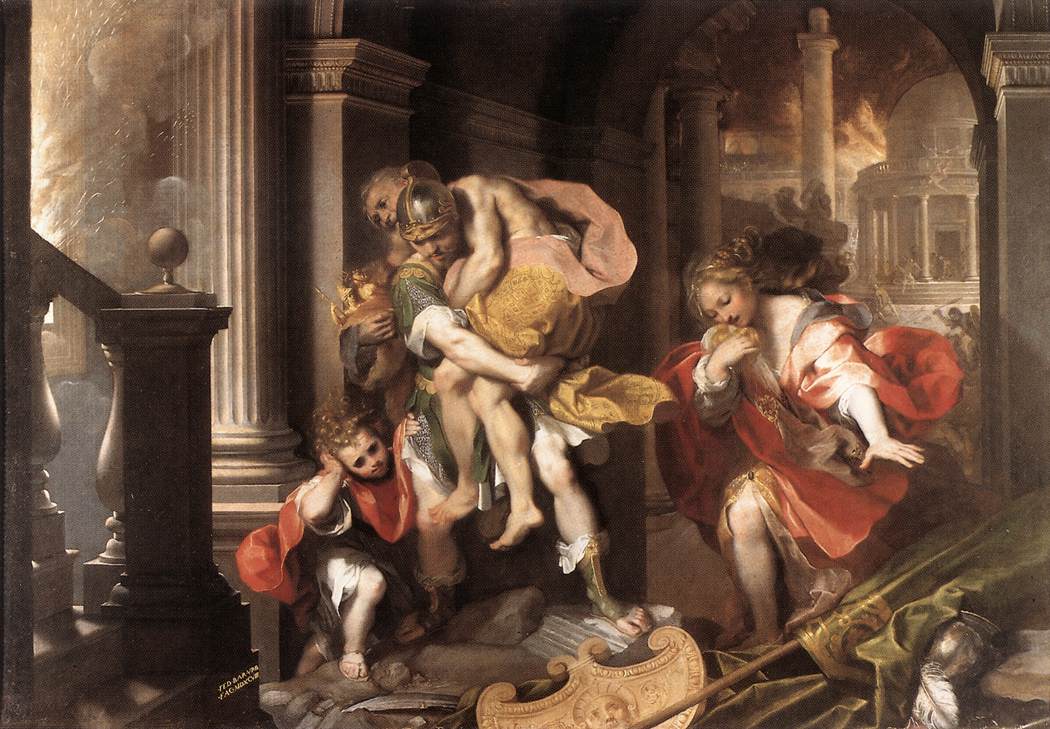
This kind of heroism is also seen throughout the Aeneid, though never in a positive light. It is the kind of heroism displayed by King Priam, who tries heroically but pointlessly to fight Pyrrhus, by Nisus and Euryalus who attack their enemy’s camp at night, but fail to get a message through to Aeneas, and by Aeneas himself when he is told by Hector to flee the burning city of Troy, but instead rushes madly through the city until his mother Venus appears to him, and urges him to save himself and his family.

In the Aeneid we see a new definition of what it means to be heroic- to be pius, to have pietas. To be pius has religious connotations, but it involves more than just piety. It involves a feeling of duty towards the gods, the state and one's family. In English it is a difficult concept to translate, but ‘dutiful’ perhaps comes closest the Roman idea. pius is the adjective most commonly used to describe Aeneas in the Aeneid, and his pietas is seen most prominently in his submission to the will of the gods, especially at personal cost (i.e. leaving Dido in book IV) and in his rescue of his family from the ruins of Troy. He does not always display such pietas- in many ways he is a flawed hero- but it is this quality which Virgil holds up as the ideal for his hero, and into which Aeneas grows over the course of the Aeneid.

Monday, September 25, 2006

Aeneid part I- A New Kind of Epic

My year 11 class are doing an introduction to the Aeneid at the moment. We'll be translating ten short passages from the Aeneid, and looking at what they tell us about its story and themes. As we go through each passage I'll post it here, along with a translation and a short discussion of what makes it an important passage. Here's the first instalment.

Aeneid I.1-7

arma virumque cano, Troiae qui primus ab oris
Italiam, fato profugus, Laviniaque venit
litora, multum ille et terris iactatus et alto
vi superum saevae memorem Iunonis ob iram;
multa quoque et bello passus, dum conderet urbem,
inferretque deos Latio, genus unde Latinum,
Albanique patres, atque altae moenia Romae.

I sing of battles, and of the man who first came from the shores of Troy, an exile of fate, to Italy and the shores of Lavinia, greatly harassed on land and sea by the power of the gods, for the sake of the unforgetting anger of Juno; many things he suffered too in war, before he could at last establish a city, and bring his gods to Latium, from whence comes the Latin race, the Alban fathers and the walls of lofty Rome.


Virgil’s Aeneid is essentially the story of a man (virum)- Aeneas, a Trojan prince who leads a band of survivors from the ruined city of Troy to a new homeland in Italy. This was a story that was well known to the Romans and had been told before by the Roman poets Naevius and Ennius. The story of the Trojan War had of course also been told by Homer from the Greek perspective in the Iliad and the Odyssey. In fact, Virgil in his first two words deliberately refers to Homer’s poems. Broadly speaking the Iliad is a poem about battle, and the Odyssey about a man- Odysseus. In fact the first word of the Odyssey is 'ανερ' (aner, man), echoed in sound by arma, and in meaning by virum. Virgil’s point is that his poem is in the same tradition of epic poetry as Homer, dealing with the same themes (wars, gods, heroes). Indeed much of the material in the Aeneid is based on Homer’s poetry, and the Aeneid is often broken into two halves; the story of Aeneas' journey in books I-VI (Virgil’s Odyssey) and the story of the battles he must fight when he reaches Italy in books VII-XII (Virgil’s Iliad). But in this passage Virgil also introduces a new element, something that sets his poem apart from those of Homer: Romae- left til the end of the sentence for emphasis and dramatic effect. Virgil’s poem is not only the story of war and heroes, it is also about Roman identity, morality and destiny. The Aeneid is in a sense Roman propaganda- written in a time when Rome was just emerging from decades of civil war it is a reflection on what made Rome great, and a vision of what Virgil hopes she (and her ruler, Augustus) may become.